


Medically reviewed by Eitan M. Kohan, MD | Reviewed August 2026
When does shoulder arthritis need surgery? The presence of arthritis on an X-ray does not, by itself, tell me that a patient needs a shoulder replacement. I pay much closer attention to what the arthritis is doing to the shoulder and how much it is limiting the patient’s life. Pain that persists despite appropriate treatment, worsening stiffness, and difficulty with everyday activities are all important parts of that decision. I also consider what non-surgical treatments have already been tried and whether they are still providing enough relief. In this post, I’ll explain the factors I look at when deciding whether shoulder arthritis is ready for surgery.
Key Takeaways
- Shoulder arthritis surgery is almost never urgent. Most of my patients try several months, sometimes years, of non-surgical treatment before surgery even enters the conversation.
- The decision usually comes down to function rather than X-ray severity. I care more about how pain affects sleep, work, and daily tasks than what the imaging alone shows.
- Night pain that will not respond to treatment and a shoulder that keeps losing motion despite therapy are two of the clearest signals that surgery is worth discussing.
What’s Actually Happening Inside an Arthritic Shoulder
Shoulder arthritis develops when the smooth cartilage lining the ball-and-socket joint gradually wears down. As that cushioning thins, the bones begin to rub against each other, and that friction is usually what produces the deep, aching pain patients describe.
Osteoarthritis is the most common form, typically tied to age and years of use, though rheumatoid arthritis and old shoulder injuries can lead to the same end result. A less common but important cause is rotator cuff tear arthropathy, where a long-standing, untreated rotator cuff tear allows the joint to wear unevenly over time.
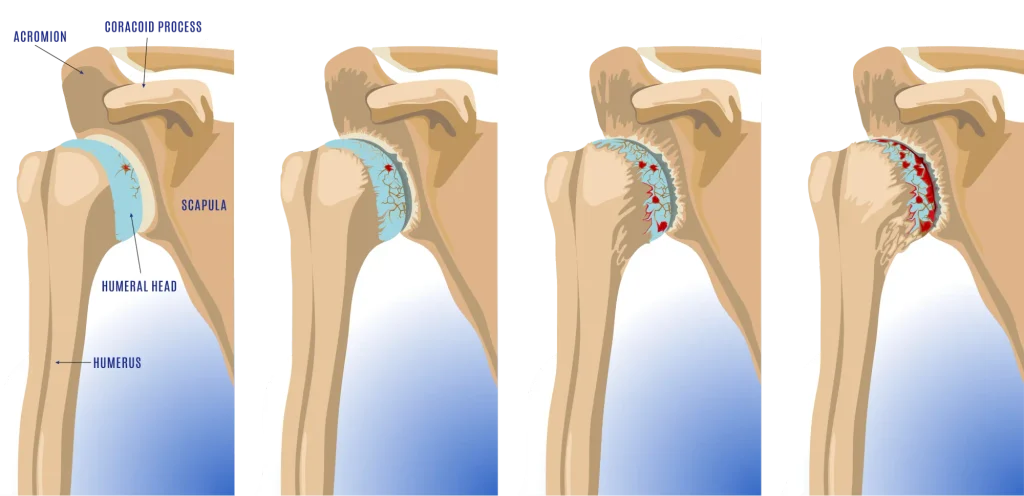
Symptoms tend to build gradually rather than appear all at once. Stiffness may show up before pain does, and both usually worsen with overhead reaching or lifting. Grinding or clicking during movement is common too, though the intensity of that sound does not always match how much cartilage damage is actually present. I have had patients with dramatic-sounding shoulders and mild arthritis, and others with a quiet joint that turns out to be badly worn. That mismatch is exactly why imaging matters more than symptoms alone when we are trying to understand severity.
Age is the most common risk factor, but it is far from the only one. Prior shoulder dislocations, fractures, or years of heavy overhead work and throwing sports can accelerate cartilage breakdown decades before it would otherwise show up. I ask every new patient about that history, because it often explains why someone in their 40s or 50s is already dealing with a joint that looks more like a much older patient’s on imaging.
What I Try Before Surgery Ever Comes Up
Nearly every patient I see with shoulder arthritis starts with non-surgical care, and most stay there for a good while. Activity modification is usually the first step: avoiding movements that consistently trigger pain without giving up activity altogether. Anti-inflammatory medication and a structured course of physical therapy come next, focused on preserving range of motion and strengthening the muscles that support the joint.
When those measures are not enough on their own, I may recommend a cortisone injection. It can calm inflammation quickly and buy meaningful relief, sometimes for months at a stretch. For select patients, PRP injections offer another option worth exploring before we talk about the operating room. Done properly and given enough time, conservative care can hold off an operation for years in the right patient, and I would rather a patient get value out of these options than rush past them.
The Signs That Tell Me Surgery Belongs on the Table
This is the part patients actually want answered: when does shoulder arthritis need surgery? A handful of signs can move that conversation forward in my office.
Night pain that keeps someone awake despite medication and modified sleeping positions is one of the strongest indicators I watch for. It usually means the joint is inflamed enough that rest alone is not calming it down anymore.
A steady loss of motion is another red flag, particularly when physical therapy has stopped making a measurable difference session to session. I also pay close attention to how long cortisone injections last. When an injection that used to provide months of relief starts wearing off in a matter of weeks, that pattern may signal the joint has progressed past what an injection can manage.
Finally, and maybe most importantly to me, I look at how much arthritis is limiting basic daily tasks: dressing, reaching into a cabinet, sleeping comfortably on that side, carrying groceries. When non-surgical treatment has not closed that gap after a genuine effort, surgery becomes a reasonable next conversation.
None of these signs work in isolation, and I rarely make this call from a single office visit. I usually want to see how a patient responds over a few months of treatment before recommending surgery, because a joint that is slow to respond today sometimes still has more room to improve than it first appears.
What I See in My Patients
A good number of the patients I treat across my Paramus, Franklin Lakes, and Montvale offices wait far longer than they need to before coming in. Some have quietly stopped playing golf, gardening, or picking up their grandchildren, assuming that is just part of getting older. What I tell them is that persistent shoulder pain is not something to accept as normal, even when it develops slowly over years rather than showing up overnight.
I have also noticed another pattern worth mentioning. Patients who come in earlier, before the joint has stiffened significantly, tend to have an easier recovery if surgery eventually becomes necessary. They typically start from better baseline motion and strength, which gives physical therapy more to work with afterward. That is part of why I would rather see someone a year too early than a year too late.
My Approach to Treatment
When a patient reaches the point where surgery is genuinely worth discussing, I start with a thorough evaluation that includes X-rays and, in some cases, a CT scan to map the extent of joint damage and assess bone quality. Whether surgery makes sense, and what type, depends heavily on whether the rotator cuff is intact.
For patients with a preserved rotator cuff, an anatomic total shoulder replacement is usually the better fit, since it recreates the joint’s natural mechanics. When the rotator cuff has significant damage alongside the arthritis, I will typically recommend a reverse shoulder replacement instead, which shifts the workload to the deltoid muscle. I walk every patient through the risks and expected outcomes of whichever option applies before we settle on a plan, because this decision should reflect a patient’s goals and health, not a standard script applied to everyone who walks through the door.
I also spend real time on the conversation about recovery before surgery ever happens, not just after. Patients do better when they know what the first few weeks look like, what physical therapy will expect from them, and roughly when they can expect to feel like themselves again.
Summary
Shoulder arthritis surgery is rarely the first move, and it should not be. Most patients do well for a long stretch with activity changes, physical therapy, medication, and injections used thoughtfully. Surgery tends to become the right conversation when night pain will not let up, motion keeps declining despite treatment, injections stop holding, or daily life has narrowed more than it should. If any of that sounds familiar, the next step is not guessing at what your X-ray means on your own. Schedule an evaluation so we can look at your specific joint, talk through how it is actually affecting your daily function, and figure out honestly where you stand.
Frequently Asked Questions
How do I know if my shoulder pain is arthritis and not something else?
Arthritis pain tends to build gradually, worsen with activity, and come with stiffness and grinding during movement. An exam paired with X-rays can usually confirm the diagnosis and rule out other causes, like a rotator cuff tear.
Can shoulder arthritis get better without surgery?
It will not reverse, since cartilage does not regenerate on its own, but symptoms may improve significantly with therapy, activity changes, and injections. Many patients manage comfortably this way for years.
What happens if I wait too long to treat shoulder arthritis?
Waiting itself is not dangerous, but prolonged stiffness and muscle weakening can make eventual surgery, if it is needed, and the recovery that follows more challenging. Earlier evaluation generally preserves more treatment options.
Will I need physical therapy even if I do not have surgery?
In most cases, yes. Physical therapy is often the backbone of non-surgical treatment, and staying consistent with it tends to make the biggest difference in how long someone can delay or avoid surgery altogether.
How long does recovery take if I do end up needing shoulder replacement for arthritis?
Most patients notice meaningful pain relief within the first several months, while full strength and motion continue to improve for six months to a year or longer. The exact timeline depends on your starting condition and how consistent you are with therapy.