


Medically reviewed by Eitan M. Kohan, MD | Reviewed August 2026
More patients have started asking me specifically about subscapularis-sparing shoulder replacement, usually after finding the term online or hearing about it from another patient in my Bergen County practice. In a standard total shoulder replacement, I have to detach the subscapularis tendon to access the joint, then repair it at the end of the case. A subscapularis-sparing shoulder replacement changes that. The tendon stays attached the whole time, which changes both the surgery itself and, more importantly for most patients, the early recovery. Here is how I think about this approach, who it fits, and what recovery actually looks like when the subscapularis is left alone.
Key Takeaways
- Subscapularis-sparing shoulder replacement leaves the subscapularis tendon intact instead of detaching and repairing it, which changes the pace of early recovery.
- The technique is more demanding for the surgeon, since it involves working around an intact tendon rather than through an open window.
- If anything about the joint anatomy makes that approach unsafe mid-surgery, I can take down the subscapularis and convert to a standard approach without changing the outcome of the replacement itself.
What Makes This Approach Different
In a conventional total shoulder replacement, reaching the joint means detaching the subscapularis tendon, one of the four rotator cuff muscles, and repairing it once the implant is in place. That repair is a big part of why early recovery is protected. The tendon needs time to heal back to bone, which is why patients wear a sling and follow a graduated lifting program for months afterward.
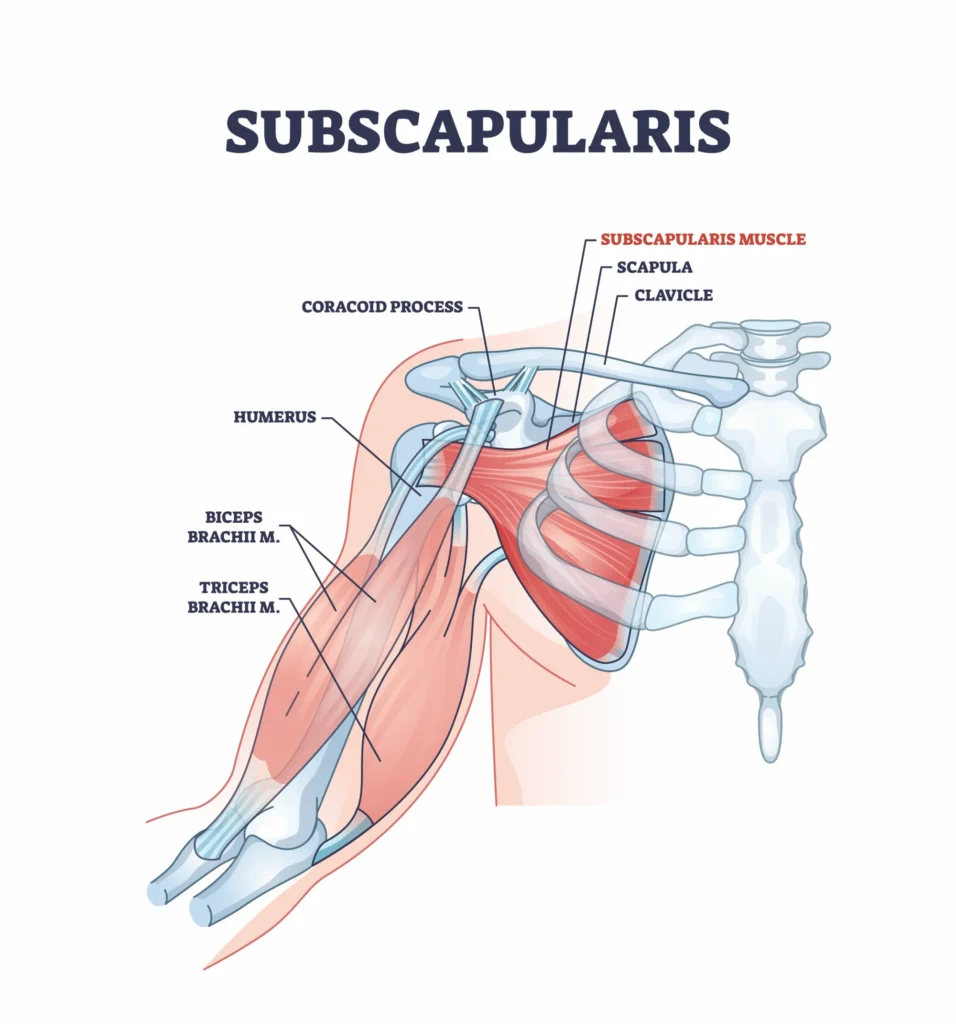
A subscapularis-sparing approach avoids that step entirely. Instead of detaching the tendon, I work around it or through a smaller window that does not require a full release and repair. Because there is no tendon repair to protect, the early restrictions built around that healing process largely go away.
It helps to understand why the standard approach exists in the first place. Full access to the joint has traditionally required detaching the subscapularis, because that tendon sits directly in the way of the humeral head and glenoid. Surgeons have relied on that exposure for decades, and it remains a well-proven way to perform a total shoulder replacement. The subscapularis-sparing technique is a newer refinement of that exposure, not a replacement for the underlying procedure, and it asks more of the surgeon in exchange for asking less of the healing tendon.
Why I Consider This Approach for the Right Patient
I will be direct: subscapularis-sparing replacement is technically more challenging to perform than a standard approach. Working around an intact tendon instead of through a fully open window takes more precision, and it is not the right fit for every joint or every surgeon’s comfort level. I only offer it to patients where the anatomy and the case itself support it.
What makes this approach worth the added difficulty, in my opinion, is the safety net built into it. If I run into anything mid-surgery, unexpected bone quality, a difficult exposure, anything that makes the subscapularis-sparing approach unsafe to continue, I can simply take down the subscapularis at that point and convert to a standard total shoulder replacement. The patient still gets a well-placed, properly functioning implant. They simply follow the standard recovery protocol afterward instead of the accelerated one. Nothing about that conversion compromises the result. It just means the more conservative recovery timeline applies.
I explain this trade-off to every candidate before surgery, because I do not want anyone walking into the operating room expecting a guaranteed accelerated recovery. In these cases, I tell patients the goal is a subscapularis-sparing approach, and that we have a safe fallback if the anatomy does not cooperate. Setting that expectation up front tends to prevent any sense of disappointment if a conversion does happen, since patients already understand it is a reasonable, planned-for outcome rather than something going wrong.
Recovery: What Changes When the Subscapularis Stays Intact
This is where the difference really shows up for patients, and it is the main reason I bring this option up at all. Because there is no subscapularis repair to protect, patients can typically come out of their sling as soon as the nerve block wears off, usually somewhere between one and three days after surgery.
Range of motion can also progress as tolerated almost immediately, rather than waiting weeks for tendon healing to reach a certain point. The main restriction in the first six weeks has nothing to do with motion. It is about load: I ask patients to avoid lifting more than one to two pounds during that stretch, since the implant and surrounding tissue are still settling in even though the tendon itself is not the limiting factor.
From weeks six through twelve, I allow a gradual increase, generally up to five or ten pounds, as strength and confidence build. After twelve weeks, roughly the three-month mark, most patients can progress strength and weight-bearing activity as tolerated, guided by how the shoulder responds rather than a rigid schedule. Compared to the sling-and-repair timeline that comes with a standard shoulder replacement, where protecting the subscapularis repair shapes almost every early decision, this is a noticeably different experience for patients in the first six to twelve weeks.
What I See in My Patients
Patients who are candidates for this approach are often surprised by how quickly they feel functional again. Being out of a sling within a few days, instead of several weeks, makes an enormous difference in day-to-day independence, especially for patients across my Paramus, Franklin Lakes, and Montvale offices who are still working or caring for family members.
I do make a point of explaining the load restrictions clearly, because patients sometimes assume that faster motion means no restrictions at all. That is not accurate. The one-to-two-pound limit in the first six weeks exists for a real reason, even without a tendon repair to protect, and patients who respect it tend to have smoother courses overall.
I also see fewer complaints of that early, frustrating stiffness that some patients describe after a standard replacement, since motion is not held back while a tendon repair matures. That said, I remind patients that faster early motion is not the same as a shorter total recovery. Building real strength still takes months, and I would rather set that expectation clearly than have someone assume they are further along than they actually are just because the sling came off quickly.
My Approach to Treatment
Candidacy for a subscapularis-sparing approach depends on the specific joint anatomy, and I evaluate that carefully with imaging before ever discussing it as an option. I also walk patients through the honest trade-off: a technically more demanding surgery for me, in exchange for a meaningfully easier early recovery for them, with the reassurance that converting to a standard approach mid-surgery remains available if the anatomy calls for it.
I use preoperative planning software called ProVoyance® to map implant position in three dimensions ahead of time, which matters even more with this technique, since precision counts for more when working around an intact tendon.
Summary
Subscapularis-sparing shoulder replacement is not a different implant so much as a different way of getting to the joint, and that difference shows up most clearly in the first six to twelve weeks of recovery. Patients typically leave the sling within days rather than weeks and can move the shoulder earlier, while still respecting real limits on lifting until the twelve-week mark. It is a more demanding procedure on my end, and it is not right for every patient, but for the right anatomy it offers a genuinely faster return to daily function. If you are considering shoulder replacement and want to know whether this approach fits your situation, schedule a consultation and bring your imaging so we can look at your joint specifically.
Frequently Asked Questions
Is subscapularis-sparing shoulder replacement the same implant as a standard replacement?
With both methods, I use the InSet® Total Shoulder System. The implant itself is the same. What differs is the surgical approach used to reach the joint, which is why the recovery timeline changes rather than the replacement itself.
Am I a candidate for this approach?
It depends on your specific shoulder anatomy, which I evaluate through imaging before recommending it. Not every patient is a fit, and I will tell you honestly if a standard approach makes more sense for you.
What happens if the subscapularis-sparing technique cannot be completed during my surgery?
I can take down the subscapularis at that point and convert to a standard total shoulder replacement during the same operation. The implant outcome is unaffected, though you would then follow the standard recovery protocol afterward.
Why can I move my arm sooner with this approach?
Because there is no subscapularis tendon repair to protect, the early restrictions built around tendon healing largely do not apply, allowing range of motion to progress as tolerated much sooner.
When can I return to normal lifting after this surgery?
Most patients progress from a one-to-two-pound limit in the first six weeks, to five or ten pounds through week twelve, and then advance strength and weight-bearing as tolerated after the three-month mark.