
Medically reviewed by Eitan M. Kohan, MD | Reviewed May 2026
As an orthopedic surgeon specializing in shoulder and elbow disorders, I see a lot of throwing athletes walk through my door carrying a very specific kind of frustration. They describe an ache on the inside of their elbow that crept up gradually and just hasn’t gone away. Many have already tried resting it, icing it, or simply pushing through.
The ulnar collateral ligament, or UCL, is one of the most important stabilizing structures in the elbow, and for overhead athletes, it’s one of the most vulnerable. Whether you’re a competitive baseball pitcher, a high school softball player, or a recreational tennis player managing a nagging inner elbow ache, understanding what a UCL injury in the elbow is, how it develops, and what your options are can help you make better decisions about your care.
Key Takeaways
- A UCL injury in the elbow most commonly affects athletes who perform repetitive overhead or throwing motions, including baseball pitchers, javelin throwers, and tennis players.
- Common symptoms include pain on the inner (medial) side of the elbow during throwing, decreased velocity or control, swelling, and a sense of looseness or instability in the joint.
- Not every UCL injury requires surgery. Mild and partial injuries may respond well to rest, physical therapy, and regenerative options such as PRP injections.
- Severe tears may require UCL reconstruction, known as Tommy John surgery.
What Is the UCL?
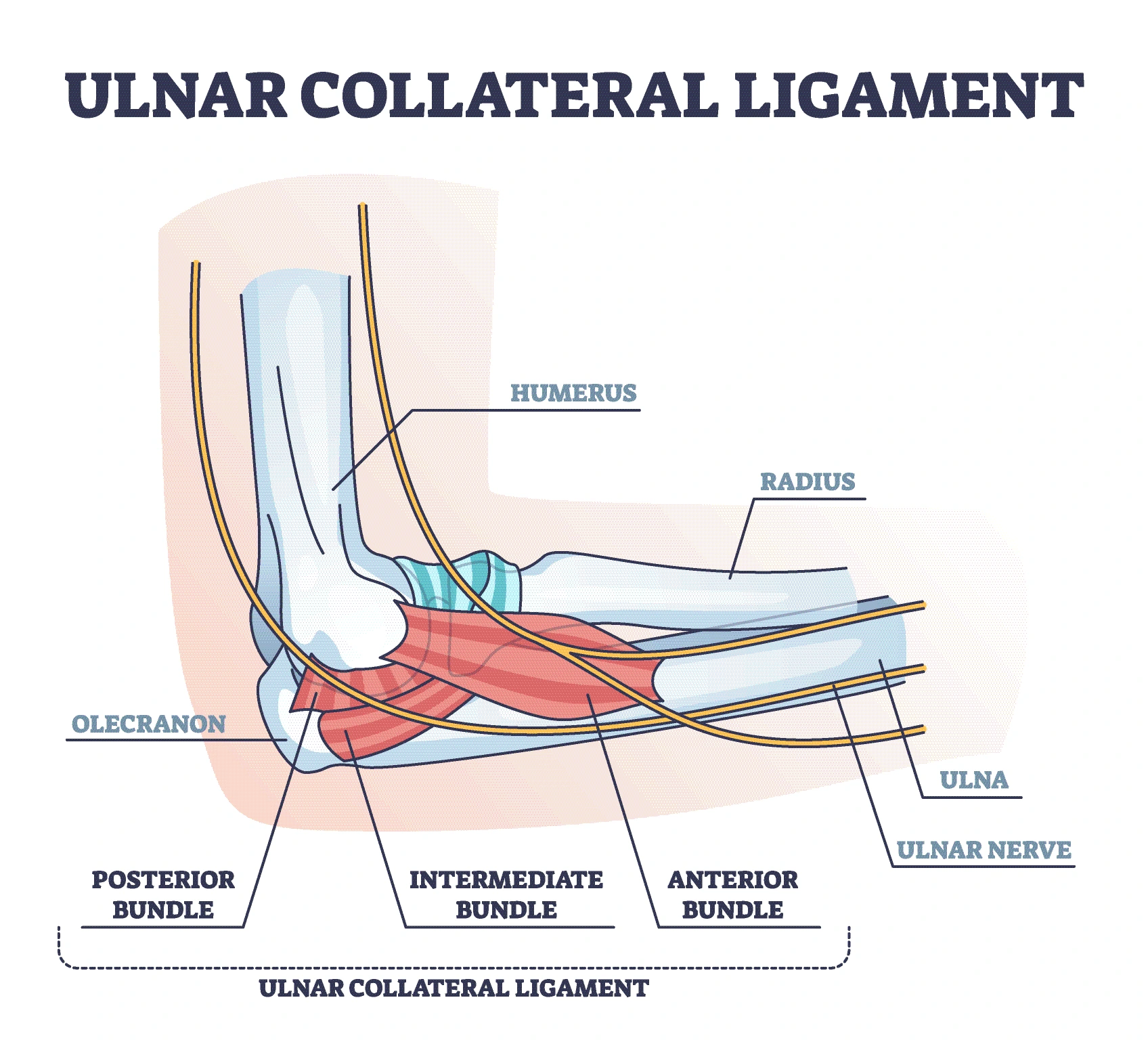
The ulnar collateral ligament runs along the inner side of the elbow, connecting the humerus (upper arm bone) to the ulna (one of the two forearm bones). Its job is to resist the outward pull the elbow experiences during overhead motion. In everyday life, most people never think about it. For a pitcher or javelin thrower, it’s working hard on every single rep.
The UCL can fail gradually or all at once. Injuries range from partial fraying, where the ligament is weakened but still intact, to a complete tear. Where a patient falls on that spectrum shapes everything: how they feel, how they perform, and what treatment actually makes sense for them.
How UCL Injuries Happen
Most of the time, a UCL injury isn’t the result of one bad throw. It builds up. Season after season of overhead throwing puts repetitive stress on the ligament, and at some point, the cumulative load outpaces the tissue’s ability to keep up. That’s why this injury shows up most often in pitchers, softball players, and javelin throwers. These athletes ask the same thing of that ligament, thousands of times over.
That said, an acute tear can happen too. Some athletes describe months of manageable soreness, then one specific throw where everything changed. That’s usually the moment a partial tear becomes something more significant.
Younger athletes are particularly worth mentioning here. I see this fairly consistently in my New Jersey practice: high school and travel ball pitchers who are throwing year-round, without real offseason rest, with no one tracking pitch counts. The ligament doesn’t get a chance to recover. That pattern is one of the more preventable ways this injury develops.
Recognizing the Signs
UCL symptoms don’t always come on dramatically. A lot of athletes describe a dull ache on the inside of the elbow that started mild and got worse over weeks or months. Others notice their velocity dropping before the pain becomes significant. Here’s what to pay attention to:
- Medial elbow pain during throwing: Typically felt on the inner side of the elbow, worst during the late cocking or acceleration phase — the moment of maximum stress on the ligament.
- Decreased velocity or control: Pitchers tend to notice this first. The arm feels fine at rest, but something is off when they actually throw.
- Swelling and tenderness: The inner elbow may feel puffy or tender to the touch along the ligament.
- A sense of looseness or instability: Some patients describe a feeling that the elbow might give way, or that it just doesn’t feel trustworthy during activity.
Occasionally, patients also report numbness or tingling in the ring and little fingers. That’s worth paying attention to, as the ulnar nerve runs right alongside the UCL, and it can get irritated as part of the same injury picture. When nerve symptoms are in the mix, I want to evaluate both.
One thing I want athletes to know: you don’t need a dramatic injury to have a significant UCL problem. A lot of people manage these symptoms quietly for a long time, hoping they’ll resolve on their own. Sometimes that works. Usually it doesn’t, and the delay makes things harder to treat.
What I See in My Practice
When patients come to see me for elbow pain at our New Jersey offices, a significant portion are overhead athletes, including high school and college pitchers, adult recreational players, and the occasional tennis athlete who has been quietly managing pain through a full season. The pattern I see most often is delayed presentation. Athletes assume medial elbow soreness is just part of throwing. Something you push through. That assumption, stretched over months, can turn a partial tear into a complete one.
When someone sits across from me describing a deep ache on the inner elbow that flares during throwing and doesn’t fully settle at rest, a UCL injury goes right to the top of my list. The physical exam tells me a lot. I palpate along the ligament, apply stress to the elbow, and watch how the patient guards. An MRI usually confirms what the exam suggests. The athletes who come in early almost always have more options than the ones who waited.
My Approach to Treatment
The first question I ask every patient isn’t, “How bad is the tear?” It’s, “What do you want to get back to doing?” The answer shapes everything. A 17-year-old pitcher who wants to throw in college has different needs than a 45-year-old recreational player who wants to get through a season. I don’t apply the same protocol to both.
For partial tears and lower-grade injuries, I typically start conservative. That means rest from throwing, a structured physical therapy program, and a progressive return-to-throwing protocol that rebuilds load tolerance gradually. In some cases, PRP therapy may be part of the picture as a way to support tissue healing without surgery.
For more severe tears, particularly complete or near-complete ruptures in athletes who need to return to competitive throwing, UCL reconstruction, or Tommy John surgery, tends to be the right call. The procedure uses a tendon graft to reconstruct the damaged ligament. I tell patients clearly: this isn’t a quick fix. Recovery is measured in months, not weeks. For the right person with the right injury and the right goals, it works well. But it’s a major commitment, and I want everyone going in with accurate expectations.
Post-surgical rehab typically spans 9 to 12 months, working through progressive phases from early healing to strength and eventually a structured throwing program before return to competition.
Recovery and Return to Sport
I’m straightforward with patients: recovery from a UCL injury takes time, whether you have surgery or not.
For athletes managing without surgery, rehabilitation focuses on rebuilding elbow and forearm strength, addressing any mechanical issues in the throwing motion, and gradually reloading the ligament through a structured return-to-throw program. We also look at contributing factors (shoulder mobility, hip and core strength, mechanics) because the elbow rarely fails in isolation.
After Tommy John surgery, the process is longer and more deliberate. We sequence recovery carefully: range of motion first, then strength, then a throwing program that starts simple and builds over months. Most athletes return to full competition somewhere in that 9 to 12 month window. Some take a bit longer. That’s normal, and rushing it isn’t something I encourage. The graft needs time to mature and integrate.
Summary
A UCL injury in the elbow is a serious problem for any throwing athlete, but it’s also one that, with the right approach, most people come back from. The key is getting an honest evaluation before things progress further.
If you’re dealing with persistent inner elbow pain or noticing a change in how you’re throwing, I’d encourage you to come in rather than waiting it out. I see patients across New Jersey through my sports medicine practice, and I’m happy to take a look, give you a real answer, and help you figure out what makes sense. Request an appointment here.
Frequently Asked Questions
Can a UCL injury in the elbow heal without surgery?
Sometimes, yes. Partial tears can do well without surgery. Complete ruptures are a different story, especially in athletes who need to return to throwing at a high level. The honest answer is that it depends on the injury and what you’re asking of the elbow. An evaluation with an experienced elbow specialist is how you can find out which situation you’re actually in.
How long is recovery after Tommy John surgery?
Plan for 9 to 12 months. The early phase is about protecting the repair and restoring motion. Then we build strength. After that, we start throwing lightly, then progressively harder over several months. The last thing I want is an athlete rushing back and re-injuring a graft that wasn’t ready. Some patients take closer to a year before they feel fully like themselves again, and that’s completely expected.
What can athletes do to reduce the risk of a UCL injury?
The biggest factors I see are volume and rest. Pitchers who throw year-round without structured downtime, or who ramp up too fast at the start of a season, are the ones most likely to end up in my office. Beyond that: following pitch count guidelines, strengthening the forearm and shoulder, and getting coaching on mechanics all help. The elbow rarely fails on its own; it usually fails because the whole system around it wasn’t supporting it the way it should.