

Medically reviewed by Eitan M. Kohan, MD | Reviewed June 2026
Elbow fractures are injuries I see as an orthopedic surgeon specializing in shoulder and elbow care here in northern New Jersey. Whether it’s an athlete who took a fall at practice, an older adult who slipped and braced themselves on the way down, or a weekend cyclist who went over the handlebars, elbow fractures can happen to just about anyone. In this post, we’ll walk through what elbow fractures are, how they’re diagnosed, and what your options tend to look like.
Key Takeaways
- Elbow fractures can involve the humerus, radius, or ulna, and each type has its own treatment path.
- Not every elbow fracture requires surgery. Some heal well with immobilization and physical therapy.
- Displaced fractures, or those involving joint surfaces, may need surgical repair to restore function.
What Is an Elbow Fracture?
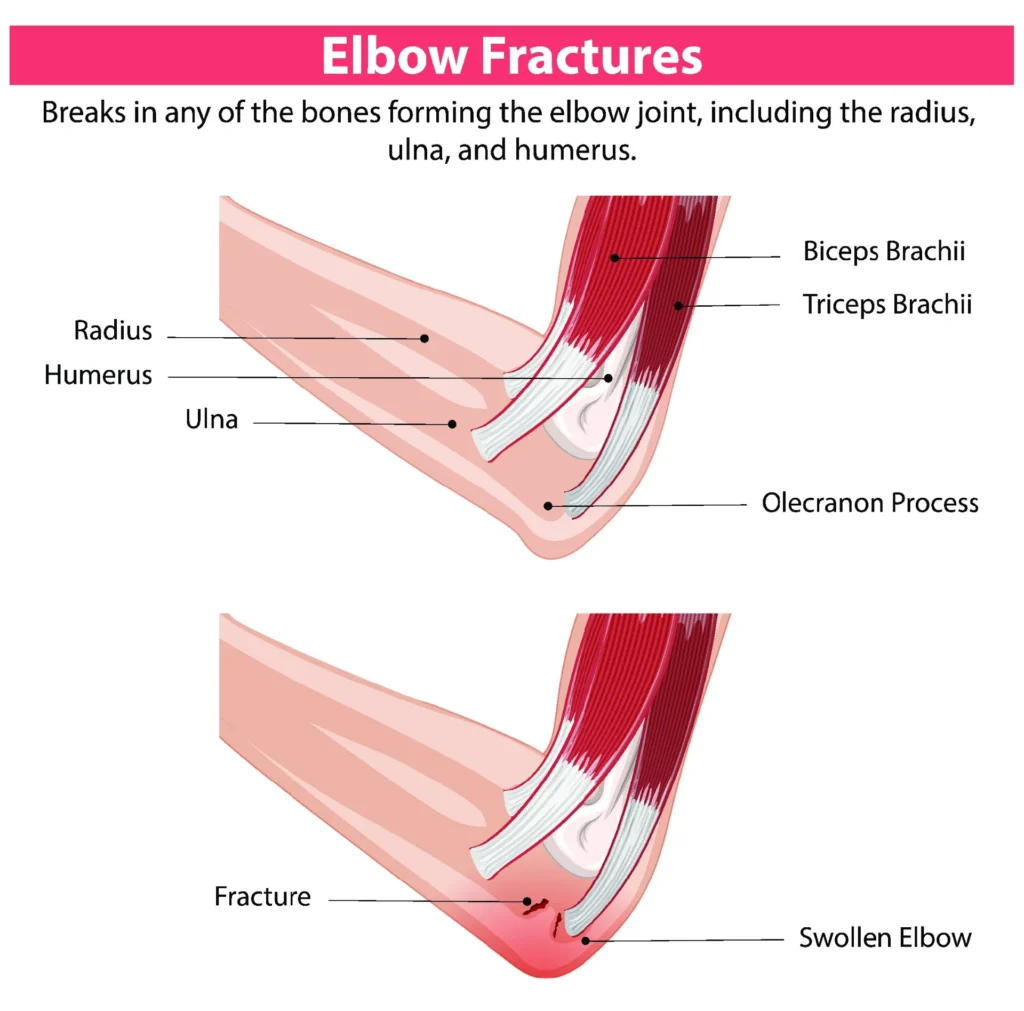
The elbow is a hinge joint made up of three bones: the humerus (the upper arm bone), the radius, and the ulna (the two forearm bones). These bones meet at the elbow and are held together by ligaments, tendons, and a joint capsule. A fracture occurs when one or more of these bones breaks, either from a direct impact, a fall onto an outstretched hand, or in some cases, a sudden forceful contraction of the muscles around the joint.
The elbow also has several important structures running through and around it, including the ulnar nerve (the nerve responsible for sensation in the ring and pinky fingers), major blood vessels, and tendons that control wrist and hand movement. That’s part of what makes elbow fractures more complex than they might seem from the outside.
Types of Elbow Fractures
Olecranon Fractures
The olecranon is the bony point of the elbow, the part that hurts when you bump it on a table corner. Olecranon fractures are the most common elbow fractures in adults and typically happen from a direct fall onto the elbow or, less often, from a sudden pull of the triceps tendon. When the bone fragments stay in place, conservative treatment may work. When they’re pulled apart (displaced), surgery is generally needed to restore the extensor mechanism of the arm (the ability to straighten your arm).
Radial Head Fractures
These fractures affect the top of the radius, where it meets the elbow joint. They’re often the result of a fall onto an outstretched hand, and they can range from small, non-displaced cracks to significantly comminuted (shattered) injuries. Mild radial head fractures often heal without surgery. More severe ones, especially those that block forearm rotation or involve multiple fragments, may require surgical fixation or, in some cases, replacement of the radial head.
Distal Humerus Fractures
This type involves the lower end of the upper arm bone, right at the elbow joint. These fractures tend to be more complex because they often involve the joint surface itself, and restoring that surface is essential for long-term elbow function. They’re more common in older adults with osteoporosis after lower-energy falls, and in younger patients after high-energy trauma like motor vehicle accidents or sports collisions. Treatment almost always involves surgery when the fracture is displaced.
Coronoid Fractures
The coronoid process is a small but important bony projection on the ulna that helps stabilize the elbow joint. Isolated coronoid fractures are less common, but they’re significant because they can compromise the stability of the entire elbow. These are often part of more complex injury patterns, like the “terrible triad,” which involves a combination of elbow dislocation, radial head fracture, and coronoid fracture.
Who Gets Elbow Fractures and Why
Falls are by far the leading cause of elbow fractures (particularly falls onto an outstretched hand). The force travels up through the wrist and forearm and concentrates at the elbow. Direct trauma, like a blow from a hard object during contact sports, can also cause fractures, especially olecranon fractures. High-energy mechanisms like car accidents, bike crashes, and extreme sports tend to produce more complex, multi-fragment injuries.
Age and bone density play a big role too. Older adults, particularly women with osteoporosis, can fracture the elbow from relatively minor falls. Younger patients generally need more force for a fracture to occur, but when it does, the fracture patterns can be more complex.
In my practice, I also see elbow fractures in athletes. Young athletes, especially, may injure the growth plates around the elbow, which require a different approach than adult fractures.
Symptoms of an Elbow Fracture
Pain is the most immediate symptom, usually sharp and localized right at the elbow. Swelling tends to follow quickly, and bruising may develop over the next day or two. In some cases, the elbow visibly looks deformed or out of place. Most people find it difficult or impossible to fully bend or straighten the arm, and some lose the ability to rotate the forearm (turn the palm up and down).
One thing I want patients to be aware of: if you notice numbness or tingling in the ring and pinky fingers, that can signal involvement of the ulnar nerve, which runs right through the inner elbow. That doesn’t necessarily mean something permanent has happened, but it’s a detail worth sharing with your doctor, because it affects how the injury is managed.
What I See in My Patients
A lot of patients arrive having already been told at an urgent care or emergency room that their elbow is “fractured.” The word “fracture” carries a lot of weight. What I try to do early in that first visit is get a clear picture of what we’re actually dealing with, because there’s a big difference between a hairline crack in the radial head and a shattered distal humerus.
In Bergen County, I see a lot of active adults and youth athletes, and elbow injuries in that population tend to come with more anxiety about what it means for their sport or their job. One of my goals is always to give people a realistic but honest picture of their recovery. Some elbow fractures are genuinely straightforward. Others take patience and a more involved treatment plan.
How Elbow Fractures Are Diagnosed
Diagnosis starts with a physical exam, checking where it hurts, assessing how much range of motion is available, and evaluating the neurovascular status of the arm (nerve function, circulation). X-rays are usually the first imaging step and can identify most elbow fractures. For complex injuries, especially those involving the joint surface or multiple fragments, a CT scan gives a much more detailed three-dimensional view.
In some situations, particularly when there’s concern about ligament injury or damage to soft tissue structures, an MRI may be ordered. This is more common in younger patients or athletes where the full picture of the injury matters for deciding on treatment.
My Approach to Treatment
My starting point with any elbow fracture is: what are the patient’s goals? That answer looks different for a 70-year-old who wants to garden without pain and a 22-year-old pitcher who wants to return to the mound. The treatment plan has to fit the person, not just the X-ray.
That said, here’s how I generally think about it:
Non-Surgical Treatment
Stable, non-displaced fractures, where the bone has cracked but the fragments haven’t shifted, can often be treated without surgery. This typically involves a splint or cast for initial immobilization, followed by a controlled transition to gentle motion exercises as the bone heals. Physical therapy plays a role in preventing stiffness.
I tend to push early motion when it’s safe to do so. The elbow is one of the stiffest joints in the body when it’s immobilized too long. Getting motion started at the right time (not too early to disrupt healing, not too late to allow stiffness to set in) is something I think about carefully for each patient.
Surgical Treatment
When fracture fragments are displaced, or when the joint surface is involved, surgery is usually the right call. The goal is to restore the bone to its proper position and hold it there while it heals. For some fractures, this means internal fixation, or holding the pieces in place with hardware. For others, particularly severe cases where reassembly isn’t feasible, a different reconstructive approach may be the better option. The right technique depends on the fracture pattern, the patient’s age and bone quality, and what I see on imaging.
Complex elbow injuries, like the terrible triad I mentioned earlier, require addressing each component of the injury in the right sequence during surgery. These cases are more involved and typically have a longer rehabilitation process, but most patients can achieve good functional outcomes with the right care.
You can learn more about the elbow conditions I treat, including fractures, on my elbow disorders page.
Recovery and Rehabilitation
Recovery timelines vary considerably depending on the type and severity of the fracture. A non-displaced radial head fracture might have someone back to most activities within 4 to 6 weeks. A complex distal humerus fracture with surgical repair may take 4 to 6 months of structured rehabilitation, and full recovery can take longer than that.
What I tell almost every elbow fracture patient: take the physical therapy seriously. The elbow does not forgive people who skip it. Stiffness is one of the most common complications of elbow fractures, surgical or not, and the only real way to prevent it is consistent, guided motion exercises starting at the right time.
For athletes, return-to-sport is a milestone we plan toward from early in the recovery. The timeline has to be guided by objective measures (strength, range of motion, function), not just how the person feels on a given day.
Summary
Elbow fractures range from relatively minor injuries that heal with immobilization to complex injuries requiring surgery and months of rehabilitation. The type of bone involved, how much displacement there is, and what structures are affected all shape the treatment decision. There’s no single path that’s right for everyone.
If you’ve had a fall or taken a blow to the elbow and you’re dealing with significant pain, swelling, or limited motion, the most important thing you can do is get it evaluated promptly. A delay in diagnosis can narrow your treatment options. I see patients at my offices in Paramus, Franklin Lakes, and Montvale. Request an appointment here.
Frequently Asked Questions
Do all elbow fractures require surgery?
No. Many elbow fractures, particularly stable, non-displaced fractures, heal well without surgery. The decision depends on the type of fracture, how much the bone fragments have moved, and the patient’s overall health and activity goals. An evaluation is necessary to determine the right approach.
Can an elbow fracture heal on its own without a cast or splint?
Certain very minor, non-displaced fractures may be managed with activity modification and a sling rather than a full cast, but this is determined on a case-by-case basis. Most elbow fractures do require some form of immobilization during early healing to prevent displacement and allow the bone to mend properly.
What happens if an elbow fracture is left untreated?
Untreated or improperly managed elbow fractures can lead to malunion (healing in a poor position), loss of range of motion, chronic pain, and in some cases, joint instability or nerve damage. Getting a prompt evaluation is the best way to protect your long-term elbow function.