


Medically reviewed by Eitan M. Kohan, MD | Reviewed June 2026
Elbow arthritis is one of those conditions that tend to sneak up on people. Patients often come to see me after months of chalking up their symptoms to soreness or overuse, only to find out that the cartilage in their elbow joint has been breaking down for some time. As an orthopedic surgeon specializing in shoulder and elbow disorders and serving patients across northern New Jersey, including Paramus, Franklin Lakes, and Montvale, I see elbow arthritis across a wide range of patients, from older adults dealing with wear and tear to younger athletes with prior joint injuries. If you’ve been dealing with elbow stiffness, pain, or a grinding sensation that just won’t quit, this post is for you.
Key Takeaways
- Elbow arthritis involves the gradual breakdown of cartilage inside the elbow joint, often causing pain, stiffness, and reduced range of motion.
- Common causes include age-related wear and tear, prior injuries, and inflammatory conditions like rheumatoid arthritis.
- Non-surgical options including anti-inflammatory medications, activity modification, and physical therapy are typically the first line of treatment.
- For more advanced cases, surgical options such as arthroscopy or elbow replacement may be considered.
What Is Elbow Arthritis?
The elbow is a hinge joint formed by three bones: the humerus, the radius, and the ulna. A layer of smooth cartilage covers the ends of these bones, allowing them to glide against each other with minimal friction during movement. The joint is also supported by ligaments and surrounded by a thin lining called the synovium, which produces the lubricating fluid that keeps things moving comfortably.
Elbow arthritis occurs when that cartilage deteriorates. As it wears away, the bones may begin to rub against each other, which can cause pain, swelling, and stiffness. In some cases, bone spurs (small bony growths) can develop along the edges of the joint, further limiting movement and adding to discomfort.
There are a few different types of arthritis that can affect the elbow. Osteoarthritis, the most common form, is essentially wear-and-tear degeneration that tends to develop gradually over time. Post-traumatic arthritis develops after a prior injury like a fracture, dislocation, or significant ligament damage that altered the mechanics of the joint. Rheumatoid arthritis is an autoimmune condition that causes the joint lining to become chronically inflamed, eventually damaging cartilage and bone. Each type has slightly different characteristics, though many of the symptoms overlap.
Symptoms of Elbow Arthritis
Elbow arthritis symptoms can develop gradually, which is part of what makes it easy to dismiss early on. The joint does not always swell dramatically in the early stages, and some patients manage the discomfort for a long time before seeking care. That delay sometimes means they arrive with a more limited range of motion than we might have been able to preserve with earlier intervention.
Pain and Stiffness
Pain is usually the first symptom patients notice. It tends to show up with activity initially, such as carrying groceries, swinging a racket, or working with your hands, and may ease up with rest. As arthritis progresses, pain can start occurring at rest as well, and morning stiffness may become a regular part of the day. Many patients describe feeling like the elbow needs time to “loosen up” before it moves comfortably.
Reduced Range of Motion
The elbow normally allows for a wide arc of motion including bending, straightening, and rotating the forearm. Arthritis can chip away at that range on both ends. Patients sometimes notice they can’t fully straighten the arm, or they’ve lost the ability to bend it as far as they could before. This matters in ways that go beyond just exercise. Reaching overhead, using tools, and even simple tasks like eating can become more difficult.
Grinding, Clicking, or Locking
Some patients describe a grinding or crunching sensation with movement, which can result from roughened cartilage surfaces rubbing together. If loose bodies, such as fragments of cartilage or bone that have broken off inside the joint, develop, patients may experience intermittent catching or locking sensations.
Swelling and Warmth
The joint may appear swollen, particularly after periods of activity. In cases involving inflammatory arthritis, there may also be warmth and noticeable tenderness around the elbow. This type of flare-up pattern (worse after activity, improved with rest) is something I ask patients about specifically, because the pattern of symptoms helps guide both the diagnosis and the treatment direction.
What I See in My Patients
In my experience, elbow arthritis tends to fly under the radar compared to shoulder or knee arthritis. People are surprised when I tell them that the elbow can develop arthritis at all. The joint sees a lot of repetitive load, especially in people who work with their hands, play racquet sports, or have a history of elbow injuries. Over time, that load adds up.
A pattern I see fairly regularly in my northern New Jersey practice is post-traumatic arthritis in patients who had an elbow fracture or dislocation years earlier and either didn’t receive follow-up care or thought the issue had fully resolved. They come back in their 40s or 50s with symptoms that trace back to a joint that never fully recovered its mechanics.
I also see rheumatoid arthritis patients who were referred to me because their elbow involvement was becoming significant enough to affect function. Managing these patients requires close coordination with their rheumatologist, because controlling the underlying disease process is part of protecting the joint.
When to See a Doctor for Elbow Arthritis
Not every episode of elbow discomfort needs an orthopedic consultation. But there are several situations where I’d encourage patients not to wait. If your elbow pain has persisted for more than a few weeks despite rest and over-the-counter medications, that’s a reasonable time to get it looked at. Same goes for pain that is consistently waking you up at night, or stiffness that is noticeably worsening over time.
If you have a history of elbow fracture, dislocation, or surgery and you’re noticing new or worsening symptoms, that warrants attention as well. Post-traumatic arthritis can develop years after an injury, so prior trauma, even something that happened decades ago, is relevant context.
My Approach to Treatment
My starting point with elbow arthritis is always a conversation. I want to understand what the patient is trying to get back to, whether that’s pain-free sleep, returning to a sport, staying on the job, or simply being able to use their arm comfortably at home. The treatment plan needs to match those goals.
For most patients, especially those in the earlier stages, we start with non-surgical management. Anti-inflammatory medications can help reduce pain and swelling. Activity modifications can take pressure off the deteriorating cartilage. Physical therapy, focused on improving range of motion and strengthening the muscles that support the elbow, can make a meaningful difference in function and comfort. I generally prefer to give non-surgical treatment a real, structured chance before considering anything else.
When those measures aren’t providing enough relief, or when symptoms are more advanced, I may discuss injection options or explore whether a procedure is appropriate. As noted on my elbow disorders page, unlike arthritis in the knee and shoulders, arthroscopy can be an effective option for removing loose bodies and cleaning the joint in the setting of elbow arthritis. In more advanced cases, particularly when the joint has deteriorated significantly and pain and functional loss are both substantial, elbow replacement may be considered.
Summary
Elbow arthritis is a progressive condition, but it’s not one you have to manage alone or wait on indefinitely. Cartilage loss doesn’t reverse on its own, but the right treatment approach can reduce pain, protect remaining joint function, and help patients stay active. The earlier we evaluate what’s happening, the more options we typically have.
If elbow arthritis symptoms are affecting your daily life, my recommendation is straightforward: don’t let it linger. Request an appointment so we can discuss what’s going on and build a treatment plan that fits your life.
Frequently Asked Questions
Can elbow arthritis go away on its own?
Cartilage loss is not reversible, so elbow arthritis doesn’t resolve on its own the way a muscle strain might. That said, symptoms can fluctuate, and many patients find meaningful relief through non-surgical treatment. The goal of management is to reduce pain, slow progression where possible, and keep you as functional and comfortable as possible.
Is elbow arthritis the same as tennis elbow?
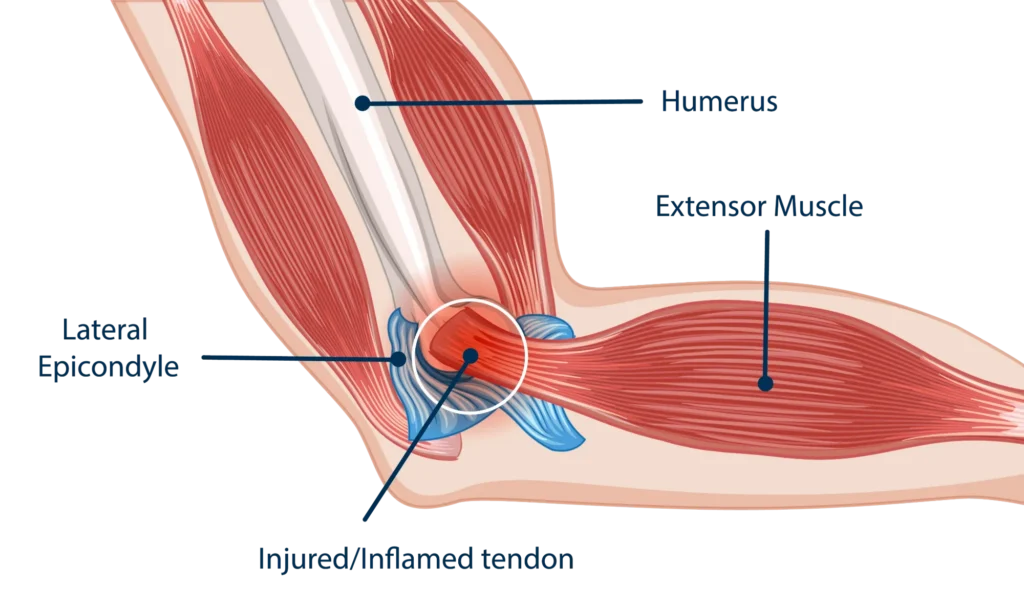
No. Tennis elbow (lateral epicondylitis) is a tendon overuse injury on the outer side of the elbow. Elbow arthritis is a joint condition involving cartilage breakdown. Both can cause elbow pain, but they are different diagnoses that require different treatment approaches.
What does elbow arthritis feel like in the early stages?
Early symptoms are often subtle. Patients may notice mild aching after activity, a slight loss of full extension or flexion, or occasional stiffness in the morning. Because these symptoms can feel similar to general soreness, many people don’t initially connect them to arthritis.
When does elbow arthritis require surgery?
Surgery may be considered when non-surgical treatment has not provided adequate relief and the condition is significantly affecting daily function or quality of life. Options may include arthroscopy to address loose bodies or clean the joint, or, in more advanced cases, elbow replacement. The right decision depends on the severity of the arthritis, the patient’s goals, and their overall health.