


Medically reviewed by Eitan M. Kohan, MD
A lot of the distal biceps injuries I treat start the same way. Someone grabs a heavy box that weighs more than expected, or tries to catch something as it falls, and feels a sharp pop at the front of the elbow. Within a day or two there’s bruising down the forearm, and the biceps muscle looks oddly bunched up toward the shoulder. A bicep tendon tear at the elbow, which surgeons call a distal biceps tendon tear, is one of the injuries where timing matters most.
Key Takeaways
- A bicep tendon tear at the elbow happens when the tendon that attaches the biceps to the forearm bone (the radius) tears, usually from a sudden heavy load.
- A completely torn tendon won’t grow back to the bone on its own, and strength may suffer without surgery, especially when turning the palm up.
- Repair is ideally done within the first few weeks after the injury.
What the Distal Biceps Tendon Does
The biceps muscle has tendons at both ends. Up at the shoulder, two tendons anchor it to the shoulder blade. Down at the elbow, a single tendon, the distal biceps tendon, attaches to a small bump on the radius called the radial tuberosity.
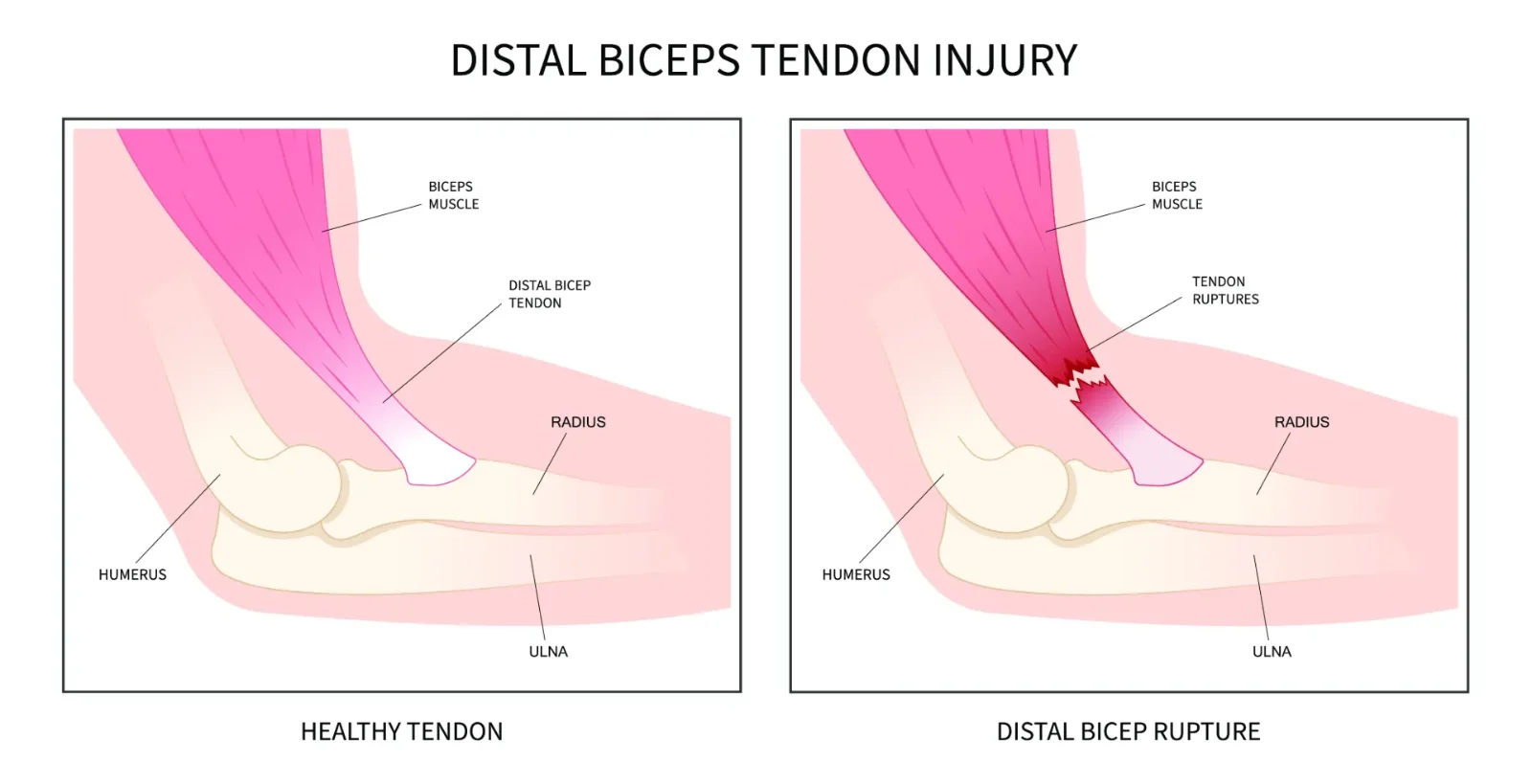
People think of the biceps as the muscle that bends the elbow. It helps, but other muscles can bend the elbow fairly well without it. The job nothing else can fully replace is supination, turning the palm up. You use it to turn a doorknob, drive a screwdriver, or twist open a jar.
Biceps problems up at the shoulder, like biceps tendonitis, are a different condition and are treated differently.
How a Distal Biceps Tear Happens
The American Academy of Orthopaedic Surgeons (AAOS) notes that these tears are uncommon, occurring in only 3 to 5 people per 100,000 each year, and rarely in women.
A classic bicep tendon tear at the elbow happens when the elbow is forced straight against a heavy load. Picture lifting a dresser with a friend when the other end suddenly drops. Your biceps fights to keep the elbow bent, the weight wins, and the tendon pulls off the bone.
Men over 30 face the highest risk. Smoking and the use of corticosteroid or anabolic steroid medications may also weaken tendons and raise the odds of a tear.
Symptoms of a Distal Biceps Tear
Three signs point toward this injury.
The first is a pop at the front of the elbow, followed by sharp pain. Bruising and swelling down the forearm often follow within a day or two.
The second is a change in the shape of the arm. When the tendon tears away, the muscle can recoil toward the shoulder and bunch up, leaving a bulge higher on the arm and a hollow at the front of the elbow.
The third is weakness, especially when turning the palm up against resistance.
Here’s the part that trips people up: the pain may settle down after a week or two. That doesn’t mean the tendon healed. A fully torn distal biceps tendon stays detached, even when the arm starts to feel better.
How I Diagnose a Distal Biceps Tear
A careful exam tells me a lot. I feel the front of the elbow for a gap where the tendon should be, and I try to hook the tendon with my finger. I also test how strongly you can turn your palm up against resistance and compare it with your other arm.
X-rays can’t show the tendon, but they help rule out a fracture. An MRI or ultrasound shows whether the tear is partial or complete, and how far the tendon has pulled back.
Why Timing Matters So Much
Once the tendon tears, the clock starts. Repair is ideally performed in the first two to three weeks after injury, before the tendon and muscle begin to scar and shorten.
Repair is sometimes possible up to about six weeks out. Past the three-week mark, though, a reconstruction becomes more likely. That means rebuilding the tendon with a donor graft, a bigger undertaking than a direct repair.
If you felt a pop at the front of your elbow and you’re seeing bruising, I’d rather see you this week than next month.
Surgery or Nonsurgical Care?
For active people with a complete tear, I generally recommend surgical reattachment. The reason is strength. Other muscles can cover for a torn tendon well enough that people keep their motion, but there is often a meaningful loss of strength, mainly in turning the forearm palm up.
Nonsurgical care is still a reasonable choice for some people. It can suit older, less active patients, or someone whose injury is in the non-dominant arm. It may also make sense for patients with health problems that raise surgical risk, or anyone who can’t commit to the rehab. Treatment then focuses on rest, anti-inflammatory medication, and physical therapy.
There are a few accepted ways to reattach the tendon, through one incision at the front of the elbow or small incisions at the front and back. I’ll explain which approach I recommend for your elbow and why.
Recovery After Distal Biceps Repair
Timelines may vary between patients, but recovery after a distal biceps repair follows a gradual progression. Right after surgery, the arm is held still in a splint or cast. Soon after, you’ll start moving the elbow again, frequently with the protection of a brace. The goal of physical therapy is to help you regain motion, then strength.
During the early months, avoid lifting with the operated arm until I clear you. The biceps tendon takes more than three to four months to fully heal, so protecting the repair during that window matters. Light everyday activities can begin fairly early, while heavy lifting and manual labor generally resume around four to six months after surgery.
What I See in My Patients
The biggest problem I see with distal biceps tears is delay. Because the pain fades within a week or two, some patients assume the injury is healing and wait it out. By the time they come in, the tendon may have pulled back and scarred, and a straightforward repair may turn into a reconstruction.
The patients I treat for this injury tend to be active adults who were lifting, moving, or catching something heavy. Some are weekend athletes or lifters. Others work with their hands for a living and depend on grip and turning strength.
My Approach to Treatment
My first question is the same one I ask about almost any injury: what do you need this arm to do? A Bergen County contractor who runs a drill all day has different needs than a retiree with a tear in the non-dominant arm. I don’t apply the same plan to both.
For an active patient with a complete tear, I typically recommend repair and try to schedule it quickly so we stay inside that early window. For a lower-demand patient, I’ll lay out the strength trade-off and support nonsurgical care if that’s the better fit.
My fellowship training focused on the shoulder and elbow, and the distal biceps is one of the elbow conditions I treat where acting early makes the most difference. I see patients across New Jersey at my offices in Paramus, Franklin Lakes, and Montvale.
Summary
A distal biceps tendon tear happens when the tendon at the front of the elbow pulls off the radius, typically during a heavy lift. The pain can fade quickly, but the tendon won’t reattach on its own, and strength often suffers without surgery. Repair works best in the first few weeks, followed by several months of protected healing and a return to heavy work around four to six months.
If you felt a pop at the front of your elbow and noticed bruising or a change in the shape of your arm, call my office at (201) 639-6620 or request an appointment as soon as you can.
Frequently Asked Questions
Can a bicep tendon tear at the elbow heal on its own?
A complete tear of the distal biceps tendon won’t grow back to the bone on its own. Plenty of people keep reasonable motion because other muscles compensate, but they may lose strength, mostly when turning the palm up.
How soon should I have surgery for a distal biceps tear?
Repair is ideally done within the first two to three weeks after the injury. It is sometimes possible up to about six weeks out, but after three weeks a reconstruction with a donor tendon becomes more likely.
How long is recovery after distal biceps repair?
The tendon takes more than three to four months to fully heal. Light daily activities can begin fairly early, while heavy lifting and manual labor commonly resume around four to six months after surgery.
Who is most at risk for a distal biceps tendon tear?
Men over the age of 30 are most likely to tear this tendon. Smoking and the use of corticosteroid or anabolic steroid medications may also raise the risk by weakening the tendon.