

Medically reviewed by Eitan M. Kohan, MD
Most people with tennis elbow never need surgery, and I’m glad to tell them so. For the small group whose pain won’t settle after months of good care, though, surgery may be a reasonable next step. When that conversation comes up in my office, patients want to know about tennis elbow surgery recovery right away. How long does it take? How much does it hurt? When will they grip a racquet, a hammer, or a coffee mug without wincing?
Key Takeaways
- Surgery may be considered when symptoms haven’t improved after an extended trial of nonsurgical care.
- The procedure removes damaged tendon tissue on the outside of the elbow and is typically done as a same-day outpatient surgery.
- Tennis elbow surgery recovery involves gentle motion after about a week, light strengthening around two months, and a return to sports around four to six months for many patients.
A Quick Refresher on Tennis Elbow
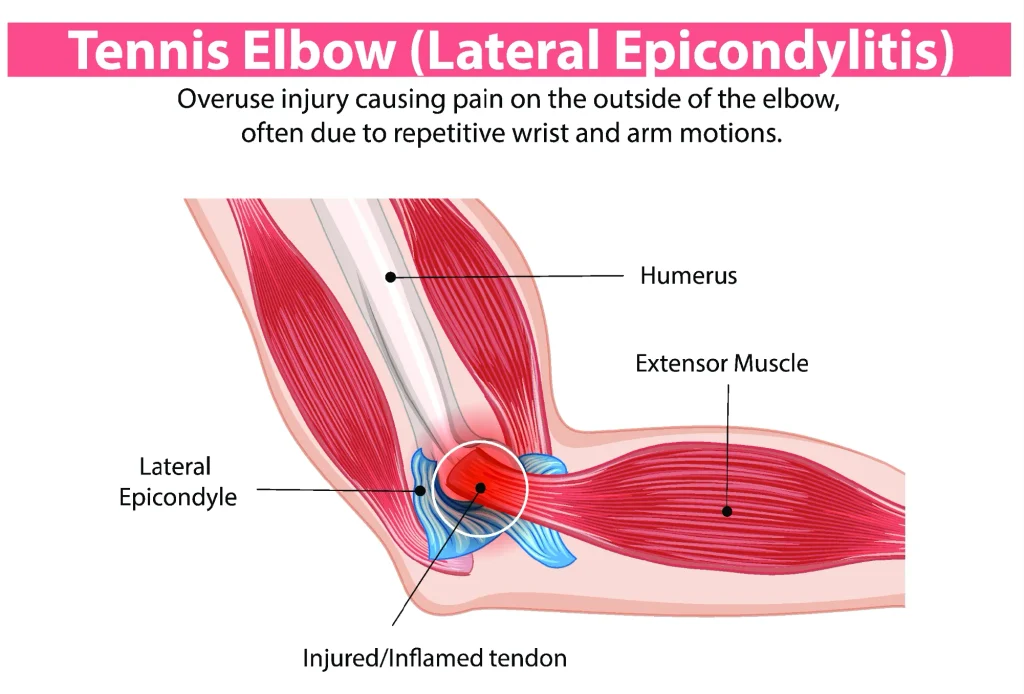
Tennis elbow, or lateral epicondylitis, is a degenerative condition of the tendons that attach to the outside of the elbow. The tendon involved in most cases is the extensor carpi radialis brevis, which helps steady the wrist when you grip. Over time, repetitive gripping and wrist extension cause tiny tears and wear where that tendon attaches to bone.
The symptoms of tennis elbow center on outer elbow pain, a weaker grip, and pain that flares when you lift or twist. It’s most common in people between 30 and 50, and painters, plumbers, and carpenters are especially prone to it.
Despite the name, many of my tennis elbow patients have never played tennis. Its cousin on the inside of the elbow, golfer’s elbow, works the same way and doesn’t require a golf club either.
Why Surgery Is Rarely My First Recommendation
The American Academy of Orthopaedic Surgeons (AAOS) reports that approximately 80 to 95% of patients have success with nonsurgical treatment. This matches what I’ve seen in my own practice. With odds like that, I want every patient to get a fair trial of conservative care first.
That usually starts with rest from the activities that set off the pain, a counterforce strap or wrist support, and anti-inflammatory medication. Exercise does the heavy lifting from there. I give many of my patients a home exercise program for tennis elbow.
If you play tennis or pickleball, your equipment deserves a look too. Stiffer racquets and looser strings can reduce stress on the forearm, and moving down from an oversized racquet head may help keep symptoms from coming back. I’d rather adjust a racquet than operate on an elbow.
For stubborn cases, injections come into the picture. I’m cautious about cortisone injections, because they can calm pain for a while, but repeated injections may weaken the tendons around the elbow. Platelet-rich plasma (PRP) is an option I discuss with patients whose symptoms hang on.
When Surgery Makes Sense
Surgery may be recommended if symptoms don’t respond to a fair nonsurgical trial, which is usually around 6 to 12 months. That’s a long time to live with elbow pain, and I understand the frustration. Still, I think a few more months of consistent therapy is a better trade than an operation for most people who are only partway through.
Before I recommend surgery, I want to be confident the outer elbow tendon is the source of the pain. Nerve compression around the elbow, arthritis in the joint, and problems in the neck can all produce similar arm pain. An X-ray, an MRI, or a nerve test can help sort that out.
What Happens During Tennis Elbow Surgery
Most surgical procedures for tennis elbow involve removing diseased tendon and reattaching healthy tendon to bone. The goal is to clear away the degenerated tissue that keeps the pain going, so healthy tendon can carry the load.
There are two main approaches. Open surgery uses an incision over the outside of the elbow and is the most common approach. Arthroscopic surgery uses miniature instruments and small incisions. Both are typically done as same-day procedures, so most patients go home the day of surgery. I’ll talk through which approach fits your elbow and your goals.
Like any surgery, tennis elbow surgery carries risks, including infection, nerve or blood vessel injury, some loss of strength or flexibility, and the possibility of needing another procedure.
Tennis Elbow Surgery Recovery, Step by Step
Timelines may vary between patients, but tennis elbow surgery recovery follows a gradual progression:
- The first week: You can move your elbow right away, but you will rest the repaired tendon by using a wrist splint. Around one week after surgery, we check to make sure the incisions are healing well and remove the sutures.
- Weeks 1 to 6: You begin exercises to stretch the elbow and restore flexibility.
- Weeks 6 to 12: You get rid of the wrist brace and light, gradual strengthening exercises begin.
- Four to six months: Many patients return to athletic activity in this window, once I clear them.
After tennis elbow surgery, hold off on heavy gripping and lifting with the operated arm until the strengthening phase begins and I give you the go-ahead. Rushing grip work early can irritate the healing tendon. Grip strength tends to be the last thing to come back.
What I See in My Patients
The patients who end up talking with me about tennis elbow surgery have usually been through a long road. They’ve worn a strap for months, done a round or two of therapy, and may have had an injection. Plenty work with their hands, as carpenters, mechanics, painters, or landscapers in towns around Bergen County. Others are recreational tennis and pickleball players who can’t get through a match.
What stands out to me is how worn down these patients are by the time they come in. Chronic outer elbow pain shows up in everything: shaking hands, lifting a pan, carrying groceries. It doesn’t sideline you all at once. It chips away at your day.
I also see a fair number of patients who never gave the exercises a full run. For them, the right next step is often a structured program, not an operation.
My Approach to Treatment
My approach is stepwise. I start with activity changes, bracing, anti-inflammatory medication, and either my home exercise program or formal physical therapy. If that isn’t enough, an injection is the next conversation, and we can discuss whether PRP makes sense for you.
Surgery enters the conversation only after a long stretch of good nonsurgical care hasn’t worked. When it does, I’m straightforward about the timeline. This isn’t a quick fix, and the months of rehab afterward matter as much as the procedure itself.
My fellowship training focused on the shoulder and elbow, so I also look beyond the outer elbow before I operate. I’d much rather catch a pinched nerve or a neck problem before surgery than after. I see patients across New Jersey at my offices in Paramus, Franklin Lakes, and Montvale.
Summary
Most tennis elbow improves without surgery, through rest, bracing, a consistent exercise program, and, in select cases, an injection. When pain hangs on for 6 to 12 months despite that care, surgery to remove the damaged tendon tissue can be a reasonable option. Tennis elbow surgery recovery takes several months, moving from a splint to stretching, then light strengthening around two months, with a return to sports around four to six months for many patients.
If you’ve been treating tennis elbow for months without relief, request an appointment and bring a list of everything you’ve tried so far, including therapy, braces, and injections, with rough dates.
Frequently Asked Questions
How long is tennis elbow surgery recovery?
The splint and stitches come off around one week after surgery, and stretching exercises begin soon after. Light strengthening starts around two months, and many patients return to athletic activity about four to six months after surgery.
How long should I try other treatments before surgery?
Surgery may be considered when symptoms haven’t improved after about 6 to 12 months of nonsurgical treatment. Within that window, I ask patients to give a structured exercise program at least 6 to 12 weeks of consistent effort before judging whether it’s working.
Will I need a cast after tennis elbow surgery?
Your arm may be held in a splint for a short time after surgery. Around one week later, the splint and stitches are removed and you start stretching exercises.
Should I get another cortisone shot instead of surgery?
Cortisone can calm tennis elbow pain for a while, but I’m cautious about recommending it. Repeated injections may weaken the tendons around the elbow, so we’ll likely look at other options, such as a structured exercise program or PRP.