
Medically reviewed by Eitan M. Kohan, MD | Reviewed July 2026
Parents and young athletes ask me some version of the same question after a first shoulder dislocation: “Does this mean surgery, or can we just rehab it and get back to the season?” Shoulder instability in young athletes is one of the more nuanced conversations I have in my practice, because the right answer genuinely depends on the athlete in front of me, not a one-size-fits-all rule. Age, sport, how many times the shoulder has slipped out, and what the imaging shows all factor into the decision. I want to walk through how I think through this, so you can ask better questions at your own evaluation.
Key Takeaways
- Shoulder instability in young athletes carries a meaningfully higher risk of repeat dislocation than in older patients, largely due to activity level and tissue characteristics.
- A first-time dislocation doesn’t automatically mean surgery, but certain factors shift the recommendation earlier.
- Contact and overhead athletes tend to face different risk calculations than those in lower-demand sports.
- Arthroscopic stabilization has a strong track record for returning young athletes to their sport when surgery is the right call.
Why Young Athletes Face a Different Risk Calculation
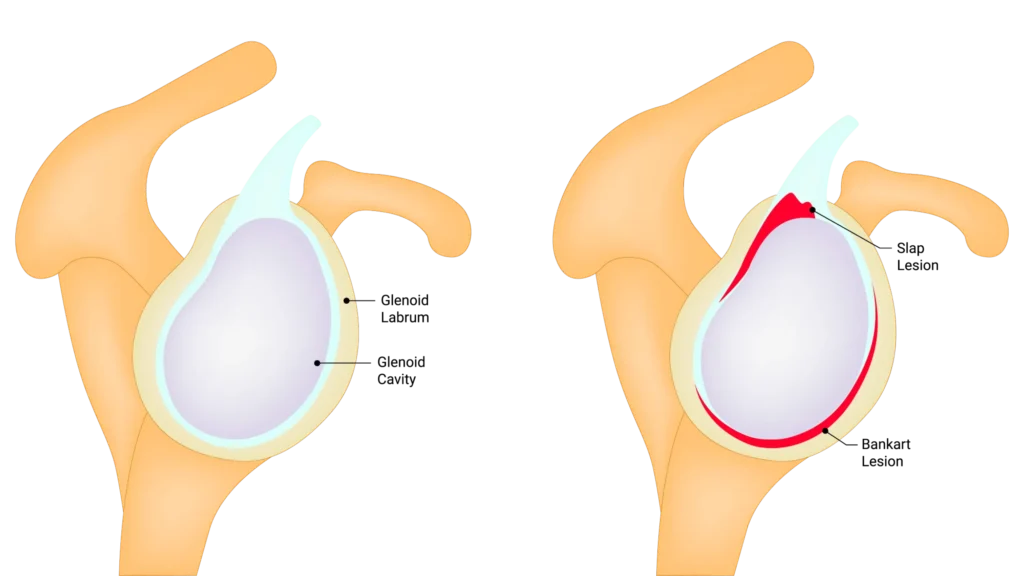
The shoulder is compared to a golf ball resting on a tee: a wide range of motion, but relatively little bony containment to keep it in place. That design relies heavily on the labrum, ligaments, and surrounding muscles for stability. When a young athlete dislocates a shoulder, especially during a contact sport or a fall, those stabilizing structures can tear, most commonly the anterior-inferior labrum, an injury known as a Bankart tear.
Age matters here. Studies and my own clinical experience both point in the same direction: the younger the athlete at the time of a first dislocation, the higher the likelihood of a repeat dislocation without treatment. High-demand sports and continued athletic activity raise that risk further. I don’t say this to alarm anyone. I say it because it directly shapes the conversation about timing. A 16-year-old varsity wrestler and a 45-year-old recreational golfer with the same MRI findings often warrant different recommendations.
What Happens Inside the Shoulder During a Dislocation
During a traumatic dislocation, the humeral head is forced out of the glenoid socket, and it may tear the labrum away from the bone as it goes. In some cases, a small fragment of bone breaks off along with the labrum, called a bony Bankart lesion. Repeated dislocations can wear away more of that bony rim over time, which changes the shape of the socket (making it more like a broken golf tee) and makes future dislocations easier to trigger, sometimes with minimal force.
This is the part I try hardest to make clear to young patients: every dislocation isn’t an isolated event. Each one can chip away at the shoulder’s own natural defenses against the next one.
Non-Surgical Treatment: When Rehab Comes First
For a first-time dislocation in a lower-demand sport, with minimal bone loss and a labrum that isn’t extensively torn, a structured non-surgical approach can be a reasonable starting point. This typically begins with a short period of immobilization, followed by physical therapy focused on strengthening the rotator cuff and surrounding stabilizers, along with neuromuscular training to help the shoulder better sense its own position during dynamic movement.
I generally give conservative treatment an honest trial when the clinical picture supports it. Rushing every dislocated shoulder straight to the operating room isn’t good medicine, in my opinion, and plenty of young athletes do return to their sport successfully after rehab alone.
When Surgery Becomes the Right Call
Several factors push the conversation toward earlier surgical stabilization rather than a prolonged rehab trial.
Recurrent Dislocations
An athlete who has dislocated more than once has demonstrated that the shoulder’s natural stabilizers aren’t holding up under the demands being placed on them. Each additional dislocation increases the risk of further labral and bone damage, which is why I take a recurrent pattern seriously even in a teenager.
Significant Bone Loss
When imaging shows meaningful bone loss on the glenoid, the socket itself has lost some of its structural containment. In these cases, a straightforward labral repair may not be enough to restore lasting stability, and a procedure to rebuild the bony support of the shoulder be considered instead.
High-Demand or Contact Sports
Athletes in collision sports like football, wrestling, or hockey, or overhead sports like volleyball and baseball, place the shoulder under repeated stress that a rehabilitated but still-torn labrum often can’t withstand. For these athletes, even after a single dislocation, I discuss surgical stabilization earlier than I might for a recreational athlete in a lower-demand sport.
A Season or Career on the Line
Timing matters practically, not just medically. An athlete heading into a college recruiting season or a senior year may reasonably choose surgery sooner to avoid the unpredictability of an in-season repeat dislocation, and that’s a legitimate factor in the decision.
What the Surgery Involves
When surgery is recommended, the most common procedure is an arthroscopic Bankart repair. Using small incisions and a camera, the torn labrum is reattached to the rim of the glenoid with small anchors, restoring the tissue’s anatomical position and re-establishing a meaningful amount of stability. For athletes with significant bone loss, a Latarjet procedure or a bone graft may be used instead to rebuild the socket’s structural support.
The right technique depends entirely on what the imaging and exam findings show for that specific shoulder. Recovery from either procedure follows a similar broad arc: a period of sling protection, followed by progressive physical therapy that rebuilds motion first and strength second.
What I See in My Patients
A good number of the shoulder instability cases I treat across my Paramus, Franklin Lakes, and Montvale offices are high school athletes here in Bergen County, wrestlers, football players, and lacrosse players especially. What I see over and over is the same pattern: a first dislocation gets reduced in the emergency room, the shoulder feels fine within a couple of weeks, and the athlete assumes the issue is behind them. Then a second dislocation happens midway through the next season, often with far less force than the first. It catches both parents and athletes off guard.
That pattern is exactly why I push for a real evaluation after any dislocation, even one that seemed to resolve quickly on its own. Catching the extent of the damage early gives us far more options than waiting for a third or fourth episode to force the conversation.
My Approach to Treatment
I don’t have a blanket rule for when surgery is right. What I do have is a consistent process: a detailed history of every dislocation or subluxation episode, a physical exam assessing the direction and degree of instability, and imaging, usually an MRI and sometimes a CT scan, to evaluate the labrum, ligaments, and bone stock precisely. From there, I lay out the real trade-offs for that specific athlete rather than defaulting to either extreme.
For athletes who do proceed with surgery, I focus heavily on a structured return-to-sport progression rather than a fixed calendar date. Clearing an athlete based purely on how many weeks have passed, without confirming strength and stability benchmarks, is how re-injuries happen. I’d rather an athlete return a few weeks later at full strength than rush back and risk undoing the repair. I also make a point of talking directly with the athlete, not just the parents, about what the surgery and recovery will actually demand of them, since their honesty about pain and function during rehab checkpoints matters just as much as anything I see on an exam.
Supporting Recovery After Stabilization Surgery
- Expect a period of sling immobilization, typically several weeks, to protect the healing repair.
- Physical therapy progresses from passive motion to active strengthening over a period of months, not weeks.
- Sport-specific training and contact clearance generally come only after strength and stability benchmarks are met.
- Full return to high-demand or contact sports often takes six months to a year, depending on the sport and procedure performed.
- Open communication with your surgeon about setbacks or new symptoms helps catch problems before they become bigger ones.
Summary
Shoulder instability in young athletes isn’t a single condition with a single treatment path. A first-time dislocation with minimal bone loss in a lower-demand sport may respond well to focused rehabilitation. Recurrent dislocations, significant bone loss, or participation in high-demand contact and overhead sports shift the conversation toward earlier surgical stabilization. The decision depends on a careful look at your athlete’s specific imaging, history, and goals, not a generic rule of thumb.
If your athlete has experienced one or more shoulder dislocations, the next step is a thorough evaluation before the next season puts that shoulder back under stress. Schedule a consultation, and we’ll map out a plan built around their sport and their timeline.
Frequently Asked Questions
Does a first-time shoulder dislocation always require surgery?
No. Many first-time dislocations, particularly with minimal bone loss and lower athletic demands, respond well to a structured non-surgical rehabilitation program. Surgery becomes a stronger consideration with recurrent dislocations or significant bone involvement.
How many dislocations before surgery is recommended?
There isn’t a fixed number that applies to everyone. Younger age, contact sport participation, and bone loss on imaging can all push the recommendation toward surgery even after just one or two episodes, while a lower-demand athlete with minimal findings may reasonably try rehab longer.
How long until a young athlete can return to sport after surgery?
Full return to high-demand or contact sports typically takes six months to a year after stabilization surgery, depending on the specific procedure and the sport’s physical demands. Return is generally based on meeting strength and stability milestones rather than a fixed date.
Can shoulder instability be prevented with training?
Targeted strengthening of the rotator cuff and shoulder stabilizers, along with proprioceptive training, may help reduce the risk in athletes with looser but not yet injured shoulders. Once a true structural tear like a Bankart tear has occurred, however, training alone typically can’t fully restore the joint’s original stability.