


Medically reviewed by Eitan M. Kohan, MD | Reviewed June 2026
I see patients every week who come in unsure whether their shoulder pain is coming from the labrum, the rotator cuff, or something else entirely. A shoulder labral tear vs. rotator cuff tear is one of the most common diagnostic questions I navigate in my practice, because both injuries can cause pain, weakness, and that nagging feeling that something just isn’t right in the shoulder. Still, they are different injuries, they affect different structures, and getting the right diagnosis changes everything about how we approach treatment.
In this post, we’ll discuss the differences between these injuries, so that whether you’re an athlete in Bergen County, a weekend golfer, or someone who just woke up one day with unexplained shoulder pain, you have a better sense of what might be going on and what to do about it.
Key Takeaways
- The labrum and the rotator cuff are distinct structures. Labral tears affect the cartilage rim of the socket, while rotator cuff tears affect the muscle-tendon complex.
- Symptoms can overlap, which is why imaging and a physical exam by a shoulder specialist are important for an accurate diagnosis.
- Some patients have both injuries at the same time, especially after a traumatic event like a dislocation.
- Treatment ranges from structured physical therapy to arthroscopic surgery, depending on the specific injury, its severity, and the patient’s goals.
A Quick Look at the Shoulder
To understand why these two injuries feel similar but require different treatment, it helps to have a basic picture of the shoulder.
The shoulder is a ball-and-socket joint. The “ball” is the head of the humerus (your upper arm bone), and the “socket” is a shallow cup on the shoulder blade called the glenoid. Because that socket is relatively shallow (think of a golf ball balanced on a tee) the joint depends heavily on soft tissue for stability.
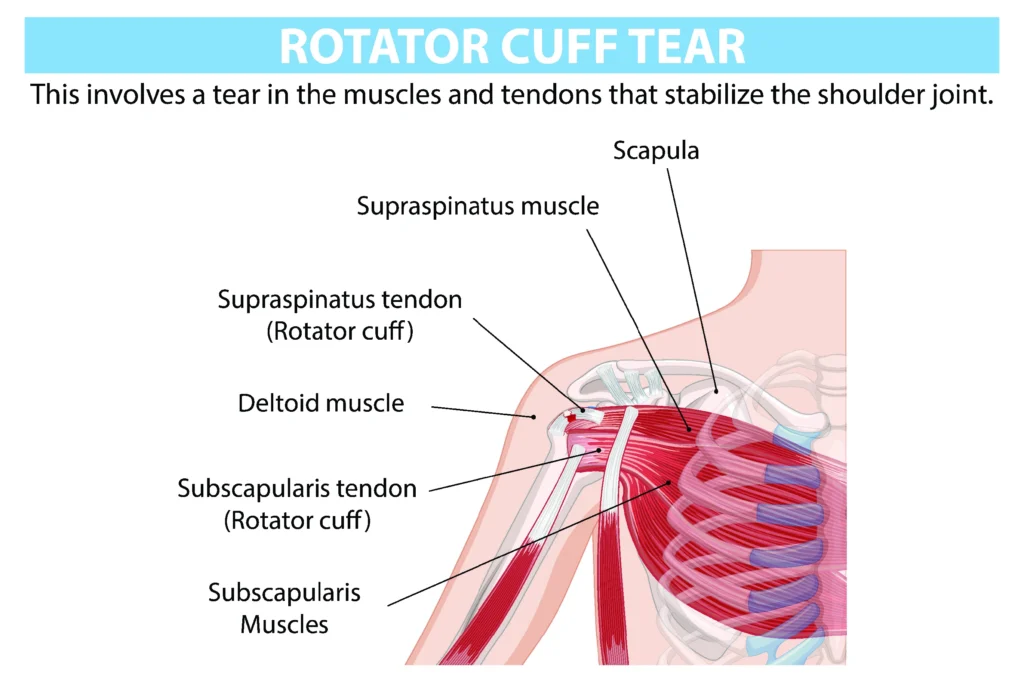
The labrum is a ring of tough, fibrous cartilage that lines the edge of that socket. It deepens the cup, anchors key ligaments, and helps keep the ball centered. The rotator cuff, on the other hand, is a group of four muscles and their tendons that wrap around the joint from above and behind. Together, they power the arm’s movement and provide dynamic stability throughout that movement. Both structures matter. Both can fail. And when they do, the shoulder lets you know.
What Is a Shoulder Labral Tear?
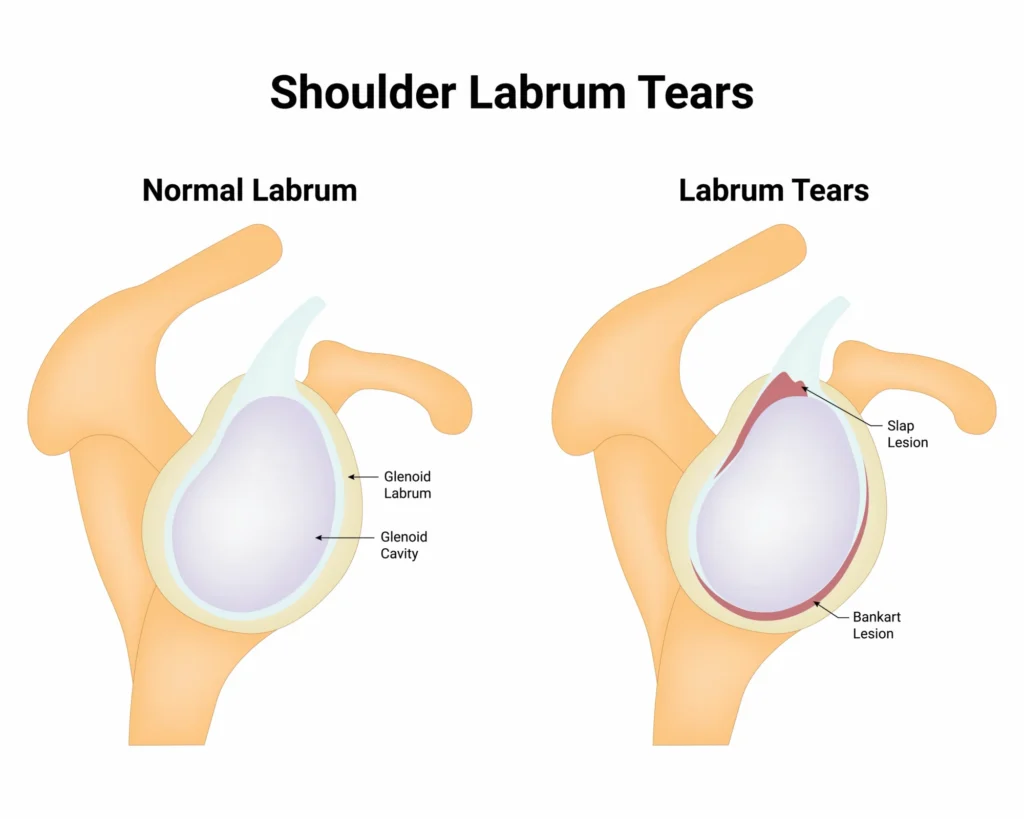
A labral tear means the cartilage rim of the glenoid socket has been damaged. This can happen at different locations around the socket, and where the tear is located tends to determine what it’s called and how it behaves.
A Bankart tear involves the front-lower portion of the labrum. This is the most common type and most commonly occurs after a traumatic shoulder dislocation. When the shoulder dislocates forward, the labrum tears away from the bone, leaving the joint less stable. A SLAP tear (Superior Labrum Anterior to Posterior) involves the top portion of the labrum, including the area where the long head of the biceps tendon attaches. This type tends to develop more gradually, particularly in overhead athletes like swimmers, baseball players, or tennis players, though it can also follow a sudden fall.
Labral tears are fundamentally stability injuries. When the labrum is compromised, the shoulder can feel loose, unpredictable, or like it wants to give way.
What Is a Rotator Cuff Tear?
A rotator cuff tear means one or more of the tendons connecting the rotator cuff muscles to the bone has been torn, either partially or completely. The supraspinatus is involved in most cases, though other tendons can be affected too.
These tears develop in two main ways. Acute tears typically occur from sudden trauma, like falling on an outstretched arm, a sudden pulling or lifting force, or a direct blow to the shoulder. Degenerative tears accumulate over time as the tendons weaken with age and repetitive use, which is why rotator cuff tears become more common after the age of 40.
The defining feature of a rotator cuff tear is weakness. Patients can often still move the shoulder, but they lose power, particularly with lifting, reaching overhead, or rotating the arm. Night pain is another hallmark, and it can be severe enough to disrupt sleep consistently.
Rotator cuff tears exist on a spectrum. A partial tear means the tendon is damaged but not fully through. A full-thickness (complete) tear means the tendon has torn all the way across. Larger tears or tears left unaddressed for extended periods can become more difficult to repair and can lead to progressive muscle changes over time, which is one of the reasons I encourage patients not to ignore persistent shoulder weakness.
How the Symptoms Differ
Here is where things get tricky, because the symptoms of a labral tear and a rotator cuff tear can look similar from the outside. Both may involve shoulder pain. Both can limit motion. Both can worsen with certain activities. The key is in the details.
Labral Tear Symptoms
Patients with a labral tear tend to present with instability as the primary complaint. The shoulder may feel loose. Some describe a feeling that the arm could slip out, or that it nearly did. Clicking, catching, or grinding sensations during movement can be present. There may be pain deep in the joint, particularly with overhead reaching or rotating the arm outward. Apprehension (hesitation before certain arm positions) is common, especially in patients who have had a prior dislocation.
Rotator Cuff Tear Symptoms
Rotator cuff tears tend to present with weakness as the main feature. Patients have difficulty lifting the arm or maintaining it elevated. Night pain is frequently severe and can make sleeping on the affected side nearly impossible. Reaching overhead, washing hair, or reaching into a back pocket can all become painful and restricted. Compared to labral injuries, rotator cuff tears tend to feel more like a loss of power than a loss of stability.
There is meaningful overlap between these two symptom profiles, though. Both can cause pain. Both can limit range of motion. Both can occur after a dislocation. When I evaluate a patient, I’m listening carefully to what their dominant complaint is. Is it instability, or is it weakness?
What I See in My Patients
The patients who come to my offices in Paramus, Franklin Lakes, and Montvale tend to fall into recognizable patterns.
Younger patients in their 20s and 30s (athletes, people active in contact sports, those who have dislocated a shoulder before) more regularly present with labral injuries. The shoulder has been stressed beyond what the cartilage could handle. Older patients, particularly those over 50 with no history of trauma, more commonly present with degenerative rotator cuff tears. The tendons have worn down gradually, and the shoulder has been quietly losing strength for a while before they come in.
But those are generalizations, and I’m careful not to let them replace the diagnostic process. I’ve evaluated patients in their 40s with significant labral tears and no prior dislocation. I’ve seen active teenagers with early rotator cuff pathology from years of competitive overhead sport. And some patients, particularly after a traumatic event, have both injuries simultaneously. A shoulder that dislocates violently can tear the labrum and damage the rotator cuff in the same moment.
Getting the Right Diagnosis
X-rays are typically the starting point. They don’t show soft tissue, but they rule out fractures and give me information about the overall anatomy and alignment of the joint. From there, an MRI is usually the most informative study for evaluating both the labrum and the rotator cuff. In some cases, I’ll order an MRI arthrogram, which involves injecting contrast into the joint beforehand. This technique can improve the visibility of labral tears, which can otherwise be subtle.
Imaging confirms the diagnosis, but it doesn’t replace the clinical picture. I’ve seen imaging findings that didn’t match a patient’s symptoms at all, and I’ve seen patients with serious limitations whose imaging looked relatively benign. Putting the story together requires both.
My Approach to Treatment
My starting point is usually non-surgical care first, as long as the clinical situation supports it. Surgery is not a default. It’s a decision I make carefully, in partnership with the patient, when conservative treatment hasn’t delivered enough improvement.
Non-Surgical Care
For both labral tears and rotator cuff tears, physical therapy forms the backbone of conservative management. For rotator cuff injuries, the focus is on strengthening the remaining cuff and the surrounding musculature to offload stress from the damaged tendon and restore function. For labral injuries, therapy targets the dynamic stabilizers, the muscles that help compensate for reduced structural stability. Anti-inflammatory medications and corticosteroid injections may also play a role in managing pain and allowing a patient to engage more fully in rehabilitation.
A small partial rotator cuff tear in a low-demand patient may respond very well to therapy and never require surgery. A complete labral tear with significant instability in a young athlete, on the other hand, may not respond to conservative care meaningfully. In those cases, I may recommend surgery earlier rather than later.
Surgical Options
When surgery is the right path, I approach both injury types arthroscopically whenever possible. Arthroscopy is a minimally invasive technique that uses a small camera and specialized instruments through tiny incisions. For a labral tear, the procedure typically involves reattaching the torn labrum to the rim of the glenoid using small bone anchors, restoring its position and function. For a rotator cuff tear, the procedure involves pulling the torn tendon back to its footprint on the bone and securing it in place.
Every surgical plan is built around what the specific anatomy requires, not a one-size-fits-all protocol.
Summary
A shoulder labral tear and a rotator cuff tear are two different injuries that can feel frustratingly similar, but they affect different structures and require different approaches. The labrum is a cartilage ring that stabilizes the socket. When it tears, instability is typically the central problem. The rotator cuff is a group of tendons that power and stabilize the arm. When it tears, weakness and pain with loading tend to dominate.
Getting the diagnosis right is the essential first step, and that means a thorough clinical evaluation combined with the right imaging. From there, most patients have options (both non-surgical and surgical) and I work to make sure those options are explained clearly and that treatment is tailored to each person’s injury, goals, and life.
If you’ve been dealing with shoulder pain, weakness, or instability that isn’t improving, I’d encourage you not to keep waiting and hoping it resolves on its own. Schedule a consultation and we can take a careful look at what’s actually going on.
Frequently Asked Questions
Can you have a labral tear and a rotator cuff tear at the same time?
Yes, and it’s not uncommon. Traumatic events like a forceful shoulder dislocation can damage both structures simultaneously. When I evaluate a patient after significant shoulder trauma, I always assess both. Treatment may need to address both injuries if that’s what imaging and examination reveal.
How do I know if my shoulder pain is serious enough to see a doctor?
If your shoulder pain is interfering with sleep, limiting your ability to use your arm in daily activities, or accompanied by a feeling of instability or significant weakness, those are signs worth having evaluated sooner rather than later.
Can a rotator cuff tear heal on its own?
Partial rotator cuff tears can sometimes stabilize and become less symptomatic with proper conservative care, but the underlying tear itself does not typically “heal” back to normal. Full-thickness (complete) tears generally do not repair themselves. Whether surgery is necessary depends on the size of the tear, the patient’s symptoms, activity level, and how the shoulder is responding to rehabilitation.