

Medically reviewed by Eitan M. Kohan, MD | Reviewed May 2026
You land on your shoulder, hard, and the first thing you do is look down. Something’s off. There’s a ridge where there wasn’t one before, sitting right at the top of your shoulder like a small tent in your skin. What you’re likely looking at is an AC joint separation, and while it can look alarming, the reality is often a lot more manageable than that bump suggests. That said, understanding what’s actually happened and knowing when to push for further evaluation can make a meaningful difference in how you recover.
Key Takeaways
- An AC joint separation is an injury to the acromioclavicular (AC) joint, where the collarbone meets the shoulder blade.
- Injuries are graded I through VI based on severity, from a mild ligament sprain to significant displacement.
- Most Grade I and II separations tend to respond well to conservative care, including rest, a sling, and physical therapy.
- Higher-grade injuries, particularly Grade IV through VI, may require surgical reconstruction.
Understanding the AC Joint
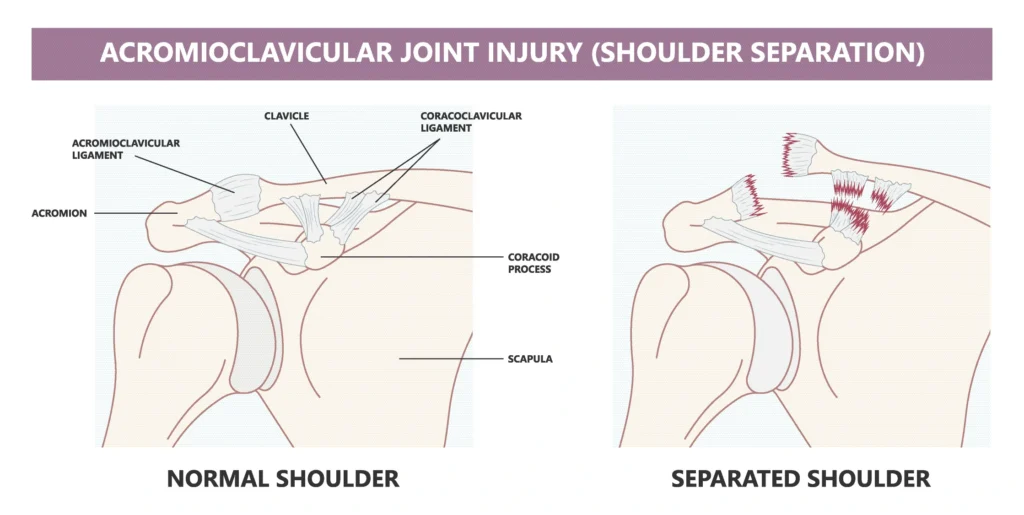
The acromioclavicular joint sits at the very top of the shoulder, where the outer end of the clavicle (the collarbone) meets a bony projection of the shoulder blade called the acromion. It may look like a small joint, but it plays an important role in transferring forces between the arm and the upper body, and in supporting shoulder mechanics during lifting and overhead movement.
Two sets of ligaments keep this joint stable: the AC ligaments, which directly connect the clavicle to the acromion, and the coracoclavicular (CC) ligaments, which anchor the clavicle to another part of the shoulder blade. When these ligaments are stretched or torn, the joint loses its ability to hold the clavicle firmly in place, and that’s what produces the characteristic bump and pain of a shoulder separation.
What Causes an AC Joint Separation?
Most AC joint separations happen from a direct blow or fall onto the tip of the shoulder. The force drives the shoulder blade downward while the clavicle stays anchored, and the ligaments that connect them absorb the impact. Common causes include:
- A direct hit to the top of the shoulder in contact sports like football, hockey, or rugby
- Falling onto the shoulder during cycling, skiing, or other outdoor activities
- Landing hard on an outstretched arm after a fall
The injury tends to be more common in active individuals and athletes, though it can happen to anyone. Here in New Jersey, where I see athletes across the board, from youth leagues to recreational adults, this is one of the shoulder conditions I encounter consistently throughout the sports seasons.
Grading the Injury
Not all AC joint separations are the same. Orthopedic surgeons typically grade them on a scale from I to VI, which helps guide treatment decisions.
Grade I involves a mild stretch or sprain of the AC ligaments, with no significant tear. The joint stays in its normal position, and pain is usually localized to the top of the shoulder. Most patients recover well with rest and conservative care.
Grade II involves a partial or complete tear of the AC ligaments, though the CC ligaments remain intact. There may be a slight upward shift of the clavicle, but displacement is minimal.
Grade III is where things become more nuanced. Both the AC and CC ligaments are torn, which typically leads to more visible displacement of the clavicle and a noticeable bump at the top of the shoulder. Treatment for Grade III injuries is sometimes debated in the orthopedic literature, and the right approach often depends on the individual patient.
Grades IV through VI are less common but involve more significant displacement and generally require surgical management.
What I See in My Patients
Most people come to me after a fall or a hard hit during a game, often directly to the side or top of the shoulder. By the time they arrive at my office, the pain at the top of the shoulder is usually sharp and tender to touch, and they’re struggling to lift the arm comfortably. Some patients have that telltale bump; others don’t, especially in lower-grade injuries.
One thing I always pay close attention to is making sure the injury isn’t being mistaken for a different shoulder problem. A separation involves the AC joint specifically. It’s not the same as a shoulder dislocation, which is a displacement of the ball-and-socket joint. I’ve had patients come in thinking they dislocated their shoulder when it was actually a separation, and the other way around. Getting that distinction right is essential, because the treatment paths are different.
Recognizing the Symptoms
The symptoms of an AC joint separation tend to be localized compared to some other shoulder conditions. Symptoms may include:
- Pain at the top of the shoulder. It may worsen when reaching across the body, lifting the arm overhead, or sleeping on the affected side.
- Tenderness directly over the joint. Pressing on the AC joint typically produces pain. In higher-grade injuries, the area may also feel unstable.
- A visible bump or deformity. In Grade III or higher separations, the displaced clavicle can create a visible prominence at the top of the shoulder.
- Limited range of motion. Movement may be restricted or painful, especially with overhead activities or reaching across the midline.
- Swelling and bruising. These may develop over the first day or two following the injury.
How AC Joint Separations Are Diagnosed
Diagnosis typically begins with a physical examination and a review of how the injury occurred. I’ll assess range of motion, strength, and areas of tenderness, and perform specific tests to evaluate joint stability.
X-rays are usually the first imaging study ordered. They can reveal any displacement of the clavicle and help rule out fractures. In some cases, stress views (X-rays taken while the patient holds a weight) may help better define the degree of instability. An MRI may also be used if there’s concern about associated damage to soft tissue structures like the rotator cuff.
My Approach to Treatment
My approach to AC joint separations is always individualized. The right treatment depends on the grade of injury, the patient’s age, activity level, and what their functional goals look like.
Non-Surgical Treatment
The majority of AC joint separations, particularly Grade I and Grade II injuries, and many Grade III cases, tend to do well with conservative management. The initial focus is on reducing pain and allowing the injured structures to begin healing.
Treatment typically starts with a period of rest and sling use to limit shoulder movement. Ice can help manage swelling in the early days. As symptoms improve, I refer patients to physical therapy, which plays a central role in restoring strength, mobility, and shoulder mechanics. Strengthening the muscles around the shoulder can help compensate for any lingering laxity in the AC ligaments.
For most Grade I and II injuries, patients can expect meaningful improvement within a few weeks to a couple of months. Some Grade III injuries also resolve well with this approach, though the timeline may vary.
Surgical Treatment
Surgical intervention is generally considered for higher-grade injuries, particularly Grade IV, V, and VI separations, where the displacement is too significant to manage conservatively. Some Grade III patients who remain symptomatic after a thorough course of non-surgical care may also be candidates.
The goal of surgical reconstruction is to restore the position of the clavicle and repair or reconstruct the damaged ligaments. Several techniques are available, and the most appropriate approach depends on the specifics of the injury and the patient’s individual needs. I walk through all relevant options with my patients before any decisions are made, so they understand both what to expect during recovery and what the longer-term picture may look like.
Summary
An AC joint separation can be a painful, disorienting injury, but for most patients, recovery is very much possible with the right diagnosis and a well-structured plan. The grade of the injury largely guides treatment: mild separations often respond well to rest and physical therapy, while more severe injuries may require surgical reconstruction. What I’ve consistently found in my practice is that patients who come in for an early, accurate evaluation tend to have the clearest path forward. If you’re in the greater New Jersey area and you’re dealing with shoulder pain after a fall or a contact injury, I’d encourage you to schedule an evaluation rather than waiting to see if it sorts itself out on its own. The sooner we know what we’re dealing with, the sooner we can put a plan in place.
Frequently Asked Questions
Is an AC joint separation the same as a dislocated shoulder?
No, these are two different injuries involving different joints. A shoulder dislocation involves the glenohumeral joint, where the upper arm bone is displaced from the socket. An AC joint separation involves the acromioclavicular joint at the top of the shoulder.
Do I need surgery for a Grade III AC joint separation?
Not necessarily. Grade III injuries sit in a middle ground where both surgical and non-surgical approaches may be appropriate depending on the individual. Factors like age, activity level, degree of displacement, and personal goals all play a role. I recommend a thorough evaluation so we can review your imaging together and discuss the options that make the most sense for you.
What happens if an AC joint separation is left untreated?
Mild Grade I and II separations often improve on their own with basic care. Higher-grade injuries that go unaddressed may lead to persistent pain, weakness, or chronic instability around the AC joint. Some patients also develop arthritic changes over time.
Where can I be evaluated for a shoulder injury in New Jersey?
I see patients at my offices in Paramus, Franklin Lakes, and Montvale, NJ. If you’re experiencing shoulder pain after a fall or contact injury, you can request an appointment online or call my office directly at (201) 639-6620 to get scheduled.