


Medically reviewed by Eitan M. Kohan, MD | Reviewed July 2026
“Why does my shoulder click and pop when I move it? Should I be worried?” I hear a version of this question almost every week in my office. Shoulder clicking or popping is one of those symptoms that can mean almost nothing, or it can be an early signal of something worth addressing. In my experience, the sound itself rarely tells the whole story. What matters more is whether it comes with pain, weakness, or a sense that the joint isn’t quite trustworthy anymore. I’ll say this upfront: most clicking shoulders I examine turn out fine. But the ones that aren’t are worth catching early.
Key Takeaways
- Shoulder clicking or popping without pain is often harmless and doesn’t necessarily require treatment.
- When clicking is paired with pain, weakness, or a catching sensation, it may point to a labral tear, tendon irritation, or early joint wear.
- A physical exam and, when needed, imaging can usually clarify what’s actually happening inside the joint.
- Most causes of shoulder clicking respond well to conservative treatment, though a smaller subset benefit from a more targeted procedure.
What Actually Causes That Clicking or Popping Sound?
The shoulder is the most mobile joint in the body, which also makes it one of the most mechanically complex. Tendons glide over bone, the labrum lines the socket, and several small compartments of fluid-filled tissue called bursae cushion the moving parts. When any of these structures shift even slightly out of their normal path, or when the surfaces they glide against aren’t perfectly smooth, you can hear or feel a click, pop, snap, or grinding sensation.
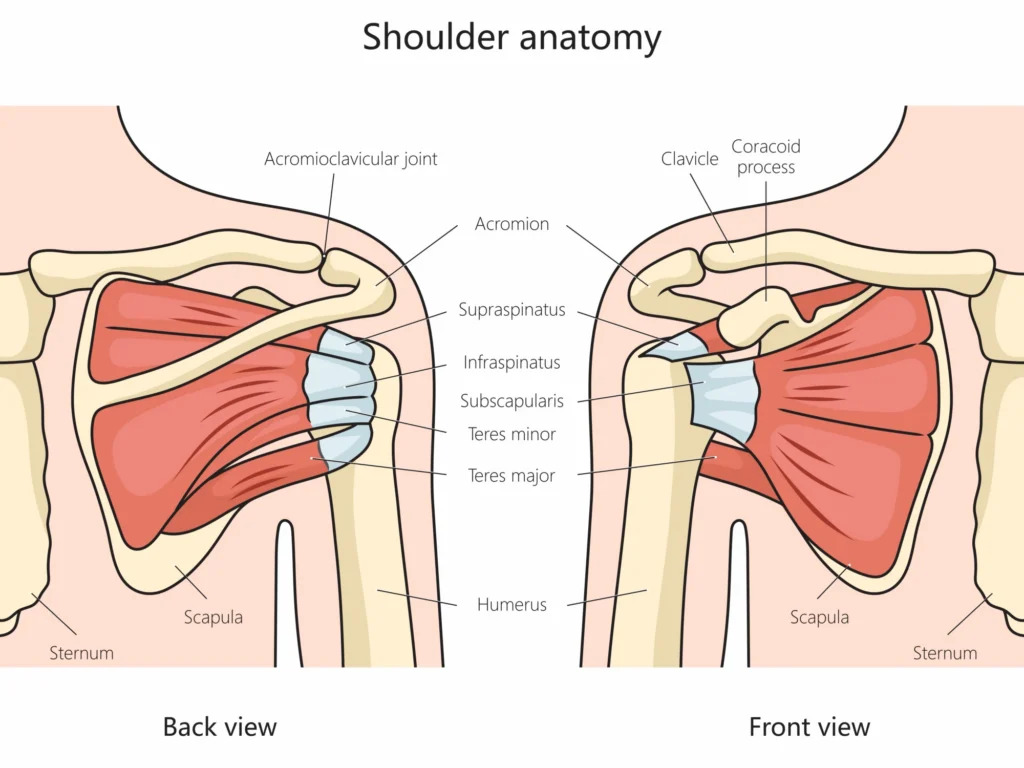
Doctors sometimes use the term crepitus to describe these sounds generally. Crepitus by itself isn’t a diagnosis. It’s a description, similar to how “cough” describes a symptom without naming its cause. Age and activity level both shape which cause is more likely. A clicking shoulder in a 22-year-old competitive swimmer usually points toward a different structure than the same complaint in a 58-year-old who’s noticed gradual stiffness over the past year, which is why I ask detailed questions about activity and occupation before I even start the physical exam.
Common Culprits Behind the Sound
Labral Tears and Catching Sensations
The labrum is a ring of cartilage that deepens the shoulder socket and helps keep the joint stable. When part of the labrum tears, whether from a dislocation, repetitive overhead motion, or gradual wear, it can create a mechanical catching or clicking feeling as the joint moves through certain positions. This type of clicking may show up alongside a sense of looseness or apprehension, particularly when the arm is raised and rotated outward. In athletes, a labral tear can develop gradually through repetitive stress rather than a single injury, so the clicking sometimes appears months before anyone connects it to anything specific.
Biceps Tendon Irritation
The long head of the biceps tendon travels through a groove at the front of the shoulder before anchoring near the labrum. When this tendon becomes inflamed or starts to slip slightly within its groove, patients frequently notice a popping sensation at the front of the shoulder, sometimes paired with tenderness when pressing directly on that area. I commonly see this in patients whose jobs involve reaching overhead throughout the day, from warehouse workers to painters.
Impingement and Rotator Cuff Irritation
Shoulder impingement happens when the rotator cuff tendons get compressed as the arm lifts overhead. This compression can create a catching or clunking sound, especially somewhere between shoulder height and just above it. Left unaddressed, ongoing impingement can progress toward a partial or full rotator cuff tear over time, which is why I generally recommend addressing it earlier rather than later.
Degenerative Changes and Joint Wear
As cartilage in the shoulder gradually wears down, the once-smooth surfaces of the joint can develop small irregularities. This produces a grinding or crunching quality to the sound, often described by patients as sand or gravel in the joint. This type of crepitus tends to develop slowly and is more common in patients over 50, though it isn’t exclusive to that age group.
AC Joint Changes
The acromioclavicular joint, where the collarbone meets the shoulder blade, is a small joint that’s particularly prone to developing arthritis or irritation from repetitive overhead work or heavy lifting. Clicking from this joint tends to localize to the very top of the shoulder and may worsen with reaching across the body.
Benign, Painless Clicking
Not every click has a clear structural cause behind it. Many people, particularly younger, flexible patients, notice occasional clicking with certain movements that comes and goes without any pain, swelling, or weakness. This can be a normal variation in how tendons or the joint capsule move and typically doesn’t require any specific treatment.
What the Location and Timing Can Tell Us
Where on the shoulder the click occurs, and what movement triggers it, can point toward a specific structure. Clicking felt deep in the joint during overhead reaching tends to suggest the labrum or rotator cuff. A pop felt at the very front of the shoulder may trace back to the biceps tendon. Clicking localized to the top of the shoulder that worsens when reaching across the body frequently comes from the AC joint. None of these patterns are perfectly reliable on their own, which is why a hands-on exam still matters more than guessing from a description alone.
Timing matters too. Clicking that showed up gradually, without any specific triggering event, is more consistent with overuse or degenerative changes. Clicking that started abruptly after a fall or a hard pull on the arm raises more suspicion for a structural tear and generally warrants a sooner evaluation.
When Clicking Is Just Noise and When It’s a Warning Sign
I tell my patients to pay attention to the company the click keeps, not just the click itself. A sound with no pain, no weakness, and no change in how the shoulder feels day to day is usually lower priority. A sound that arrives with pain, a sense of instability, night pain that disrupts sleep, or a noticeable drop in strength deserves a closer look.
What I See in My Patients
Across my Paramus, Franklin Lakes, and Montvale offices, shoulder clicking is one of the more common reasons patients schedule a first visit, right alongside general shoulder pain. What strikes me is how often patients have been living with the sound for months, sometimes years, quietly assuming it’s just part of getting older or part of being active. I also see a fair number of weekend athletes and pickleball players here in Bergen County whose clicking shows up specifically during their sport, often tied to a particular swing or serving motion.
I’ve also treated plenty of patients whose clicking turned out to be entirely benign, and that’s worth mentioning too, since it’s easy to assume the worst once you start researching symptoms online. Sometimes the most valuable thing I can offer isn’t a treatment plan. It’s reassurance backed by an actual exam.
My Approach to Diagnosis and Treatment
When a patient comes in with shoulder clicking, I start with a detailed history. When did it start? Does it hurt? Is there a specific position that triggers it? From there, a physical exam usually narrows the possibilities considerably, since different structures tend to produce clicking in fairly predictable patterns of motion.
If imaging is warranted, I typically start with an X-ray to evaluate the bones and joint spaces, followed by an MRI if I suspect a soft tissue issue like a labral tear or rotator cuff problem. I don’t order imaging automatically for every patient with clicking. In my view, imaging should answer a specific clinical question, not serve as a reflexive first step.
When treatment is needed, I favor starting conservatively; physical therapy focused on scapular mechanics and rotator cuff strengthening resolves a meaningful share of clicking cases tied to impingement or mild tendon irritation. Surgery becomes part of the conversation when there’s a structural tear that isn’t responding to conservative care or is affecting stability.
Self-Care Steps Worth Trying First
- Pay attention to which specific movements trigger the click and note whether pain accompanies it.
- Avoid repetitive overhead activity for a short period if the clicking is new or worsening, to see whether it settles down.
- Apply ice after activity if there’s associated soreness or swelling.
- Gentle range-of-motion and scapular stability exercises can sometimes reduce mechanical clicking tied to muscle imbalance.
- Keep a simple log of when the sound occurs. That pattern can be more useful to your doctor than you’d expect.
When to See a Doctor
Clicking paired with any of the following deserves a proper evaluation rather than a wait-and-see approach: pain that persists or worsens, a sense that the shoulder might give way or slip out of place, night pain that interferes with sleep, noticeable weakness when lifting or reaching, or clicking that began suddenly after a fall, collision, or specific injury. My shoulder disorders page covers several of the underlying conditions that can produce these symptoms in more detail.
Summary
Shoulder clicking or popping is common, and in many cases, it’s genuinely nothing to worry about. The sound becomes more significant when it’s paired with pain, instability, weakness, or a noticeable change from your baseline. Labral tears, biceps tendon irritation, rotator cuff impingement, and general joint wear are among the most frequent causes I evaluate in my practice, and each has a fairly distinct pattern on exam. If your shoulder has been clicking alongside pain or a sense that something isn’t quite right, the next step is a hands-on evaluation rather than continued guessing. Schedule a visit, and we’ll figure out together whether that sound is background noise or a signal worth addressing.
Frequently Asked Questions
Is shoulder clicking always a sign of a tear?
No. Many people experience painless clicking that isn’t related to any structural tear. Clicking becomes more concerning when it’s accompanied by pain, weakness, or a sense of instability.
Can shoulder clicking go away on its own?
In some cases, yes, particularly when it’s related to muscle imbalance or minor tendon irritation that improves with activity modification and targeted strengthening. Clicking tied to a structural issue like a labral tear typically won’t resolve without more focused intervention.
What kind of doctor should I see for a clicking shoulder?
An orthopedic shoulder specialist can evaluate the pattern of clicking, perform a targeted physical exam, and determine whether imaging or further treatment is appropriate.
Does a clicking shoulder mean I need surgery?
Not usually. Most causes of shoulder clicking respond well to conservative treatment such as physical therapy and activity modification. Surgery is generally reserved for cases involving a confirmed structural tear that hasn’t improved with non-surgical care.