

Medically reviewed by Eitan M. Kohan, MD | Reviewed May 2026
One of the more surprising diagnoses I give patients is calcific tendonitis of the shoulder. They come in expecting a rotator cuff tear, or maybe early arthritis. The most common response is some version of: “Calcium? In my tendon?” I understand the confusion. Calcific tendonitis of the shoulder doesn’t always make the shortlist when people research shoulder pain online, but I see it regularly in my New Jersey practice. And it can produce intense discomfort.
Key Takeaways
- Calcific tendonitis of the shoulder occurs when calcium deposits form inside the rotator cuff tendons, causing pain and sometimes a significant inflammatory response.
- The condition most commonly appears in adults between 30 and 60 and can affect active, otherwise healthy individuals with no prior shoulder history.
- Symptoms range from a mild, persistent ache to a sudden, severe flare that can make moving the arm in any direction extremely difficult.
- Most cases respond well to non-surgical treatment, though some patients may need a procedure to address the deposits directly.
What Is Calcific Tendonitis?
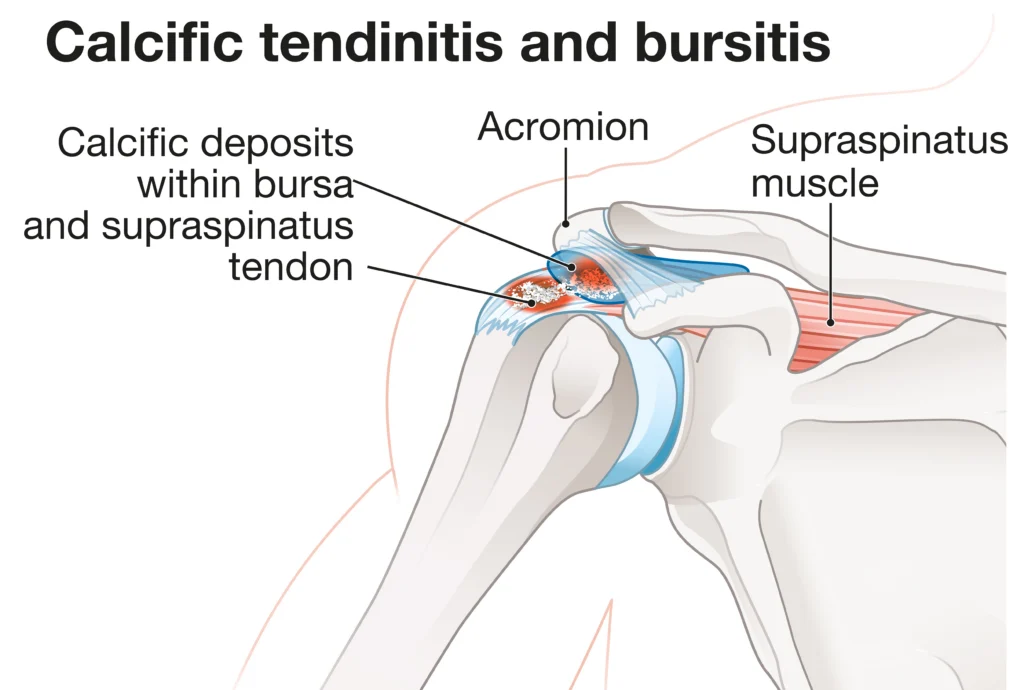
Calcific tendonitis is a condition in which calcium deposits form within one or more of the rotator cuff tendons. The rotator cuff is a group of four muscles and their attached tendons that work together to stabilize the shoulder and control arm movement. The supraspinatus tendon, which runs along the top of the shoulder joint, is the most commonly affected.
In a healthy tendon, the tissue is dense and fibrous. When calcium builds up within it, the deposit can range from a soft, chalk-like material to a harder, crystallized formation depending on the phase of the process. The buildup creates internal pressure within the tendon. When the body begins to reabsorb the deposit, it triggers an inflammatory response in the surrounding tissue. I hear from patients that the reabsorption phase is when they feel the sharpest, most disabling pain.
Calcific tendonitis of the shoulder also tends to mimic impingement syndrome, since the deposit can reduce the space available for the tendons to glide beneath the shoulder’s bony arch. Many patients have been treated for impingement for months before a calcium deposit is identified on imaging. This is a good reason to make sure imaging is part of the evaluation.
What Causes It?
There isn’t one single cause. Repetitive overhead activity, whether from sports like swimming, tennis, or volleyball, or from work demands like painting or construction, can place recurring stress on the rotator cuff over time. Some research points to a possible connection between metabolic conditions like thyroid disorders and diabetes, though the relationship isn’t fully established. Genetics appear to play a role in some patients.
Calcium deposits can exist without causing any symptoms at all. They’re occasionally found on X-rays taken for an unrelated reason.
What I See in My Patients
Most patients who come to me with calcific tendonitis of the shoulder fall into one of two groups. The first has been dealing with a persistent, low-grade ache for months, sometimes longer. They’ve tried rest and over-the-counter medications, maybe some stretching, and nothing has fully resolved it. The second group walks in after a sudden, severe pain onset that stopped them mid-activity. No injury, no fall, nothing obvious. Just intense, disabling shoulder pain that arrived without warning.
That second group is typically in the acute inflammatory phase, when the body is actively trying to break down and reabsorb the deposit. It can be dramatic. I’ve had patients come in unable to lift their arm past waist height, convinced something had to have torn. What imaging shows instead is a deposit in the process of breaking up, which is actually the body doing what it’s supposed to do. That’s not how it feels in the moment, and I always make a point of telling patients that upfront.
Recognizing the Symptoms
Persistent pain with overhead activity is one of the most common complaints, along with nighttime discomfort that disrupts sleep. Some patients describe a pinching sensation during specific movements and gradually worsening stiffness over time. During an acute flare, the shoulder may feel warm and swollen, and even minor arm movements can be intensely painful.
How Is It Diagnosed?
Diagnosis starts with a clinical evaluation and a physical examination. Tenderness over a fairly specific area of the shoulder and pain reproduced with certain movements are typical findings. In my experience, patients are often surprised by how precisely the exam can localize where the problem is before we’ve even looked at imaging.
X-rays are usually the most informative first step. Unlike soft-tissue injuries, calcium deposits typically show up clearly as dense white areas within the tendon on a standard X-ray. Ultrasound provides real-time detail about the deposit’s size, consistency, and the surrounding tissue’s response. An MRI may be ordered when I want to assess the broader condition of the rotator cuff and rule out a concurrent tear.
My Approach to Treatment
Calcific tendonitis of the shoulder responds well to treatment in the large majority of cases. Here is generally how I approach it.
When a patient comes in during an acute flare, getting the inflammation under control is the priority. That means relative rest, anti-inflammatory medications, and in some cases a corticosteroid injection to reduce the acute response. Once the pain settles enough for the patient to move and engage, I want them in physical therapy, as the shoulder doesn’t recover well with prolonged immobility.
For patients in the chronic, lower-grade phase, physical therapy is usually the foundation. Strengthening the rotator cuff and the muscles that stabilize the shoulder blade, restoring range of motion, and gradually reloading the shoulder under progressively greater demand are the priorities.
When conservative care hasn’t provided enough relief after consistent effort, I typically consider ultrasound-guided needling, also called barbotage. This involves inserting needles directly into the deposit under live ultrasound guidance, breaking the material up, and flushing it out with saline. This is performed under local anesthesia or light sedation to make patients comfortable while it is done. Most patients tolerate the procedure well and notice meaningful improvement within a few weeks. Extracorporeal shockwave therapy is another non-surgical option I may discuss with selected patients, using targeted sound wave energy directed at the deposit to stimulate reabsorption.
A smaller number of patients eventually need minimally invasive arthroscopic surgery to remove the deposit directly. I reserve this for patients who have not responded to the approaches above and in whom the deposit is causing ongoing, significant functional limitation.
When Should You See a Doctor?
If your shoulder pain has lasted more than a few weeks without improving, or if you’ve had a sudden severe onset that limits your movement, don’t wait it out. Calcific tendonitis shares symptoms with other shoulder disorders, including rotator cuff tears and impingement syndrome, and the right treatment depends entirely on what’s actually causing the pain. Managing symptoms without a diagnosis can mean treating the wrong thing for a long time.
I see patients throughout northern New Jersey at my offices in Paramus, Franklin Lakes, and Montvale. If shoulder pain is keeping you from doing what you need to do, getting an evaluation is the right first step.
Summary
Calcific tendonitis of the shoulder develops when calcium deposits form within the rotator cuff tendons, producing pain that ranges from a chronic, low-grade ache to a sudden, severe flare. Diagnosis is generally straightforward with X-rays and a physical examination. Treatment begins conservatively with physical therapy, anti-inflammatory medications, and injections, and can escalate to ultrasound-guided procedures or arthroscopic surgery when needed. The most important first step is getting the diagnosis right so that treatment is aimed at the right problem.
Frequently Asked Questions
Can calcific tendonitis resolve on its own?
Sometimes. The body may gradually reabsorb the deposit over time, and some patients see their symptoms improve without intervention. The timeline is unpredictable, and the reabsorption process itself can be the most painful part of the whole experience. Most patients benefit from treatment to manage symptoms during that period, even when surgery is never needed.
Is calcific tendonitis the same as a rotator cuff tear?
No. A rotator cuff tear involves tearing of the tendon tissue itself. Calcific tendonitis involves calcium deposits forming within a tendon that may otherwise be structurally intact. They can coexist, and they can produce similar symptoms, which is exactly why imaging is such an important part of the evaluation.
How long does recovery typically take?
It depends on the treatment approach. Patients who respond to physical therapy and injections often notice meaningful improvement within several weeks to a few months. Those who undergo barbotage or arthroscopic removal follow a structured recovery program, and many see improvement within a few months of the procedure.